




Mokama Murder: Bihar's Caste Fault Lines Reopen as Bahubali Politics Silences the Promise of Progress
- | Tuesday | 4th November, 2025
By Animesh Ikshit
In the sweltering heat of Bihar’s election season, a single act of violence has torn through the fragile narrative of progress. On 30 October, in Mokama, Dular Chand Yadav, a local strongman and supporter of Prashant Kishor’s Jan Suraaj Party, was fatally shot in broad daylight. His political association with Jan Suraaj coexisted with personal links to the RJD, reflecting the fluid loyalties that continue to define Bihar’s volatile political landscape.
Eyewitnesses describe the attack as swift and deliberate. Dular Chand was struck by bullets in the leg, but it was the internal trauma that proved fatal. The post-mortem report from Patna Medical College and Hospital confirmed a ruptured lung and multiple fractured ribs, which caused massive internal bleeding and cardiac arrest. His death has once again pulled Mokama into the vortex of Bihar’s long history of political violence and caste rivalry.
The principal accused, Anant Singh, the JD(U)’s fiery candidate and self-styled “Chhote Sarkar”, has long embodied both influence and intimidation in the region. He was arrested together with seventy-nine others but continues to deny any role, stating, “My car was ahead; I do not know who pulled the trigger.” The Jan Suraaj candidate from Mokama, Piyush Priyadarshi, was also arrested in connection with the case, widening the investigation and blurring the lines between parties and caste alliances.
A State Shaped by Strongmen
To understand the significance of this killing, one must return to the foundations of Bihar’s political order, where the Bahubali – literally “strong-armed man” – filled the vacuum left by weak institutions and failing governance.
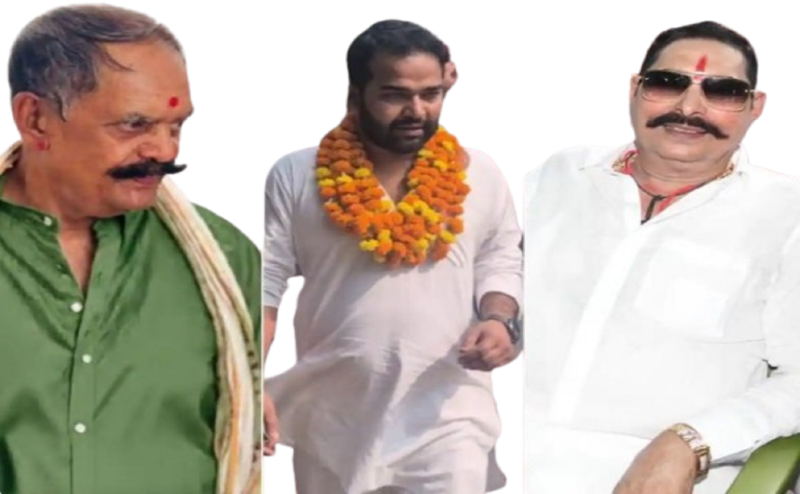
From the 1970s to the 1990s, as the state’s administrative machinery eroded, men of muscle emerged as local enforcers and protectors. Surajbhan Singh in Mokama, Mohammad Shahabuddin in Siwan, Anand Mohan in Saharsa, Pappu Yadav in Madhepura and Anant Singh in Barh evolved from feared gangsters into political power brokers. Alongside them stood Prabhunath Singh of Chapra, a Rajput leader now serving a prison term for murder, and the Shukla brothers of Vaishali – Kaushlendra “Chhotan” Shukla and Vijay Kumar “Munna” Shukla, both Bhumihar strongmen who reshaped the violent politics of north Bihar in the 1990s.
Their influence rested on caste solidarity and a vacuum of governance. For the marginalised, they offered protection and access; for political parties, they delivered votes and muscle. By the late 1990s, nearly one in three MLAs in Bihar faced criminal charges. The line separating the neta and the goonda had all but disappeared.
Yet the Bahubali phenomenon was not limited to upper-caste power. With the rise of Lalu Prasad Yadav and the implementation of the Mandal Commission, a new generation of Yadav strongmen emerged to assert backward-caste influence. Sadhu Yadav, Lalu’s brother-in-law and a former MP, became the emblem of political muscle within the RJD’s structure, wielding power from Gopalganj to Patna. Subhash Yadav, another influential Yadav leader from central Bihar, used his networks to anchor the RJD’s reach across the state. Reetlal Yadav, the independent MLA from Danapur with deep RJD roots, later embodied the continuation of that muscular politics in the capital’s periphery.
Together, these figures – Yadav, Bhumihar and Rajput alike – entrenched the idea that muscle, caste pride and politics were not opposites but interdependent forces within Bihar’s democracy.
The Bahubali as an Idea
To portray the Bahubali merely as a figure of fear is to ignore his cultural and psychological resonance. In Bihar’s layered caste hierarchy, he came to symbolise protection, pride and representation.
For Yadavs, the rise of Lalu Prasad and his kin, including Sadhu Yadav, Subhash Yadav and Reetlal Yadav, represented long-denied social justice and empowerment against upper-caste dominance. For Bhumihars and Rajputs, figures such as Anant Singh, Prabhunath Singh and the Shukla brothers embodied pratishtha, the restoration of pride after the Mandal-era upheavals.
Across communities, the strongman remains both condemned and celebrated. In districts where bureaucracy moves slowly and justice feels distant, he is still perceived as someone who “gets things done” – a parallel authority that commands fear yet ensures access. In this distorted moral landscape, the gun becomes an instrument of justice where the law itself appears absent.
The Bahubali is therefore not a deviation from Bihar’s democracy but one of its most visible by-products. When the state fails, the strongman fills the void.
Mokama’s Mirror: Caste Over Change
Mokama, long marked by rivalry between Yadavs and Bhumihars, has once again become a battleground of caste prestige.
The killing of Dular Chand Yadav has deepened the divide. The Yadav community, which Anant Singh had been attempting to court to widen the JD(U)’s caste base, has turned inward in anger and mistrust. The Bhumihars, meanwhile, have largely rallied behind Singh, viewing his arrest as politically motivated rather than impartial. The detention of Piyush Priyadarshi, Jan Suraaj’s candidate, further demonstrates how caste identity transcends political party boundaries.
In this environment of suspicion and reprisal, the issues that matter most – irrigation, employment, education and health – have receded into the background. The conversation on governance has again been replaced by the rhetoric of revenge.
Fear Mobilises Faster Than Facts
The tragedy of Bihar’s democracy lies in its repetition. Every few years, a murder rekindles caste loyalties, reshuffles alliances and silences discussions on policy.
Fear, not fact, dictates mobilisation. Caste arithmetic, not competence, determines leadership. Roads remain unfinished, schools underfunded and youths unemployed, while political discourse centres on honour and humiliation. Emotion continues to overwhelm evidence because it mobilises faster.
In Bihar, as elsewhere in India, blood still mobilises faster than blueprints.
A Call Beyond Caste
The Mokama murder is not simply a local crime; it is a mirror reflecting the contradictions of Indian democracy. If Bihar truly hopes to move beyond its Bahubali legacy, its electorate must reward governance rather than intimidation.
Let Dular Chand’s death not become another statistic buried under caste arithmetic. Let it serve instead as a call to conscience. Development must regain its primacy over dominance, and progress must triumph over pride.
Only when Bihar learns to value irrigation over intimidation and skill centres over strongmen will it realise the promise that democracy once held. Only then will the ballot truly belong to Bihar, not merely to its divides.

If You Like This Story, Support NYOOOZ
Your support to NYOOOZ will help us to continue create and publish news for and from smaller cities, which also need equal voice as much as citizens living in bigger cities have through mainstream media organizations.
Stay updated with all the Latest Patna headlines here. For more exclusive & live news updates from all around India, stay connected with NYOOOZ.
