
Rahul Gandhi: Emergence from ridicule to relevance in people's mind
- | Wednesday | 23rd July, 2025

BY-Alok Verma
In a democracy where silence often masquerades as strategy and verbosity is dismissed as immaturity, two political personas dominate India’s imagination — Prime Minister Narendra Modi and Leader of the Opposition Rahul Gandhi.
Modi, the most strategically silent leader in independent India’s history, has institutionalised one-way communication — radio monologues, social media broadcasts and scripted interviews. Press conferences remain out of bounds. On the other hand Rahul Gandhi speaks frequently and spontaneously — often derided for it — but his persistence is finally beginning to pay political dividends.
For a long time Gandhi was dismissed by the establishment and media alike as a dynastic misfit, lampooned as “Pappu” and mocked even by allies. But this caricature is slowly collapsing under the weight of his recent political positioning and popular outreach. From being ignored Gandhi has become a political force that the Modi government cannot sidestep.
Take for example the government’s earlier resistance to the caste-based census — a policy demand which Gandhi championed aggressively. By linking welfare schemes to the principle of “population justice”, he turned the issue into a question of equity, not just identity. Despite initial dismissal by the BJP, the government was eventually compelled to take a more open stance, especially after Bihar conducted its own caste survey and national attention shifted.
Similarly, Gandhi’s unwavering stance on the now-repealed farm laws rattled the government. His warnings about corporatising agriculture and abandoning minimum support mechanisms were ridiculed at first, but as protests intensified and international attention mounted, the government unceremoniously withdrew the laws — without debate or accountability.
On foreign policy too, Gandhi has thrown tough questions. His critique of India’s handling of the China border situation, especially after the Galwan clash in 2020, questioned the government`s claim that “no one entered Indian territory.” Gandhi cited satellite images, third-party analyses, and statements by military veterans to support his argument. Rather than responding with data, BJP leaders attacked him for “demoralising the armed forces” and being “China’s spokesperson.”
More recently, Gandhi’s relentless questioning of Operation Sindoor, India’s covert cross-border response to terror, and the failure to pre-empt or prevent the Pahalgam massacre — in which 26 civilians, including 25 tourists and a pony-ride operator, were brutally killed by Pakistani-sponsored terrorists on April 22, 2025 — compelled the Modi government to concede to a formal debate in the ensuing Monsoon Session of Parliament.
His specific query — “Wasn’t the promise after abrogation of Article 370 that terrorism would vanish from Jammu & Kashmir?” — was backed by the government’s own figures: over 500 terror incidents and more than 125 security personnel deaths since August 2019. These facts placed the government in an uncomfortable spotlight.
In response, BJP ministers didn’t offer data-backed rebuttals but instead launched personal attacks — questioning Gandhi’s patriotism, foreign visits and invoking historical baggage such as the Emergency, 1984 Sikh riots, or minority appeasement policies attributed to the Congress. However, as many political observers argue, it is both unfair and unconvincing to hold Rahul Gandhi accountable for the policies or missteps of his great-grandfather or grandmother. Today`s electorate seeks accountability for today`s issues.
Despite the BJP`s offensive tactics, Gandhi is finding renewed political traction among ordinary citizens. Unemployment levels have fluctuated between 7.1% and 8.2% over the past year (as per CMIE), youth joblessness is estimated at nearly 42%, and healthcare inflation continues to outpace income growth. These are not abstract failures — they affect everyday lives. Gandhi persistently highlights these concerns, backing his claims with publicly available data from NSSO, RBI and parliamentary committee reports.
He has also amplified the growing frustration around skyrocketing costs of private education, uncapped hospital charges, air pollution and the rise in public sector disinvestment. His criticism of “corporate capture” of policy directly points to industrial giants Adani and Ambani, naming them boldly in Parliament and public rallies. His remarks during the Adani-Hindenburg episode forced the government onto the defensive, even as it blocked opposition demand for a Joint Parliamentary Committee probe.
His Bharat Jodo Yatra, stretching over 4,000 kilometres, reshaped perceptions. It was not just a symbolic march, but a social reawakening where he listened to people across castes, religions, professions and economic classes. It helped reposition him not just as a leader of a party, but as a voice of ordinary Indians.
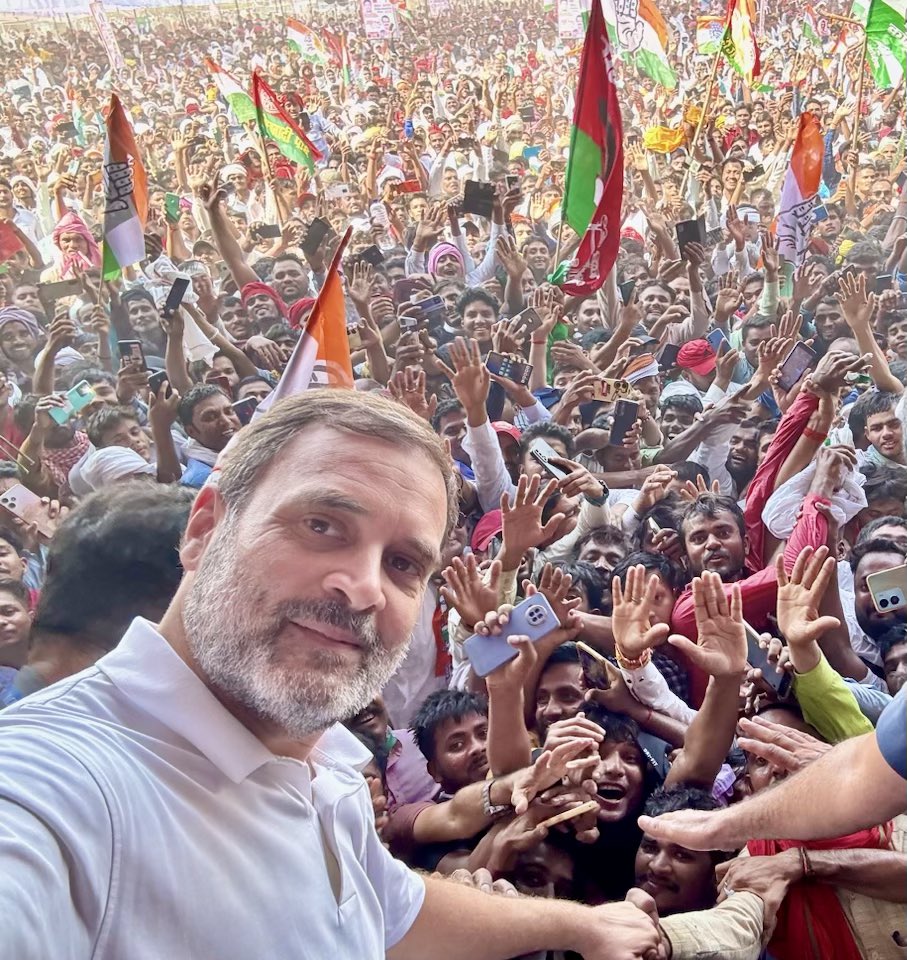
Rahul Gandhi is now seen by many as a people’s agony aunt — a leader who listens, empathises and speaks without fear. His engagements with street vendors in Delhi, students in Hyderabad, MSME owners in Surat and factory workers in Tamil Nadu project an image of direct connection — a quality often missing in the current regime, which is increasingly seen as distant, arrogant and preoccupied with image management.
However, Rahul Gandhi’s political evolution is not without its own contradictions. His apparent obsession with criticising almost every policy of the Modi government, even those broadly considered beneficial, raises questions about his political maturity. Whether it is the expansion of national highways under the Bharatmala project, the Clean India Mission (Swachh Bharat Abhiyan), UPI-led digital payment revolution, or Ayushman Bharat healthcare coverage — Gandhi has rarely acknowledged or praised any of these efforts.
Such a posture undermines his otherwise legitimate criticisms on issues like unemployment, corporate favouritism, or public sector erosion. In a democracy, constructive opposition includes both criticism where due and appreciation where deserved. A leader’s ability to distinguish between the two marks maturity. In Gandhi’s case, his reluctance to recognise even tangible public service achievements dilutes the credibility of his overall critique.
This tendency has made many voters cautious — especially India’s growing urban middle class and young first-time voters — who expect pragmatism and fairness over political one-upmanship. If Rahul Gandhi is to be seen as a future national alternative, his evolution must include not only stronger messaging and public outreach but also an ability to rise above partisan reflexes when national interest is genuinely served.
The results of the 2024 Lok Sabha elections, where Gandhi won both Rae Bareli and Wayanad with record margins, and Congress secured over 99 seats, are proof that public perception is shifting. He is no longer the political liability his critics once portrayed; he is now the face of the most credible opposition in a decade.
This transformation is not cosmetic — it is the outcome of consistent public engagement, data-backed criticism, and courage to question a dominant narrative. Whether Gandhi can now unify disparate opposition forces, resist provocations and stay consistent in his messaging will determine whether he can truly challenge Narendra Modi in the 2029 general election.
But one thing is already clear: Rahul Gandhi is no longer a fringe figure in Indian politics.
You may like him, dislike him, or disagree with his methods, you can no longer ignore him. His facts are firmer. His questions sting deeper. And his voice is being heard louder than ever in the corridors of power.
(The writer is National Award winning journalist & Founder www.nyoooz.com)

If You Like This Story, Support NYOOOZ
Your support to NYOOOZ will help us to continue create and publish news for and from smaller cities, which also need equal voice as much as citizens living in bigger cities have through mainstream media organizations.
Stay updated with all the Delhi Latest News headlines here. For more exclusive & live news updates from all around India, stay connected with NYOOOZ.