11 Years of Modi Era Reforms: Are Indians Better Off Today ?

  • | Monday | 25th August, 2025

BY-Alok Verma

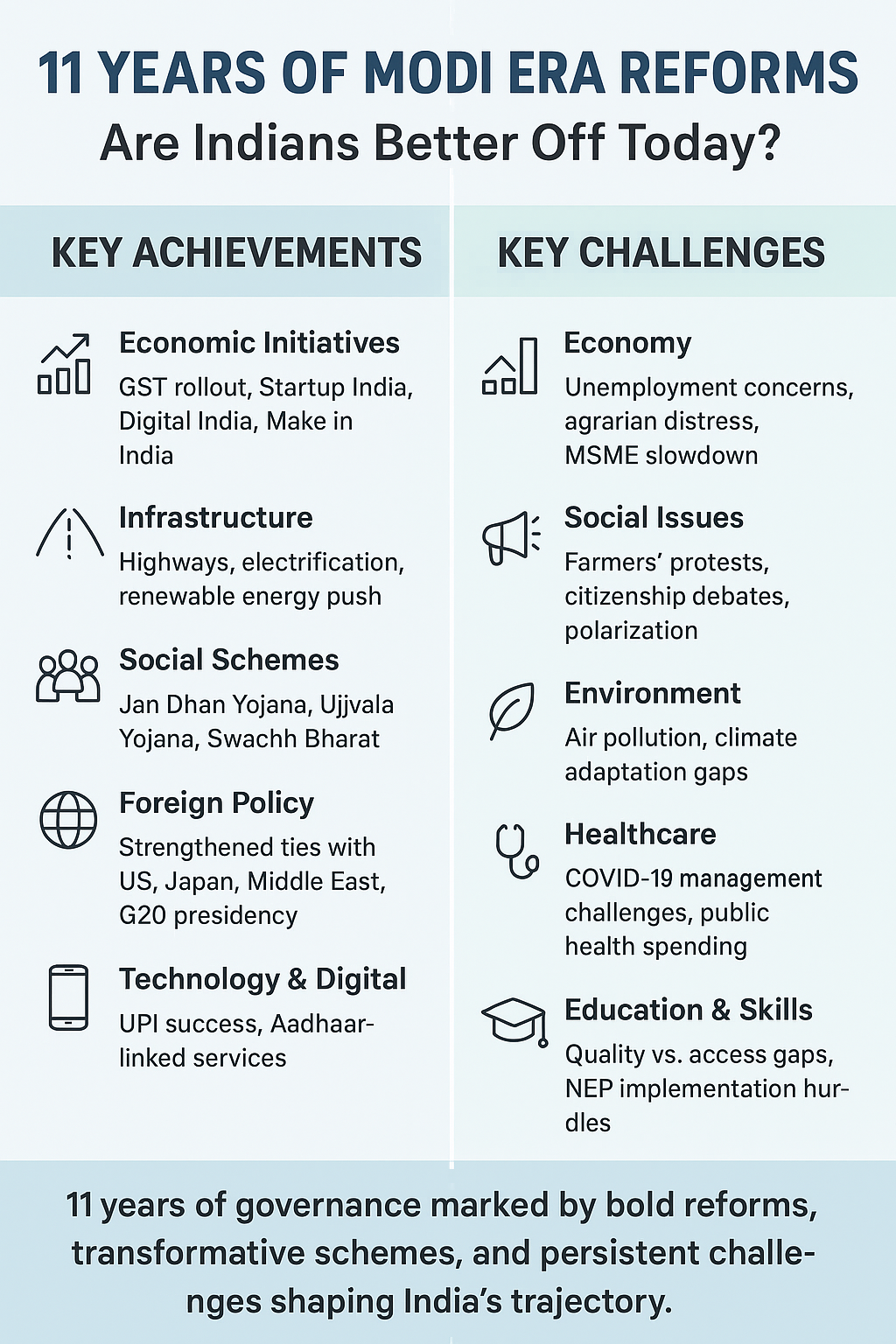
When Narendra Modi became Prime Minister in 2014, he promised a “New India” built on reforms, transparency, and growth. Eleven years later, India stands as the world’s fastest-growing large economy on several measures, yet the daily life of millions of Indians raises a sobering question: are people truly better off? The answer lies in a paradox. Macroeconomic performance tells one story of growth and reform momentum, while household realities tell another of inflation, job insecurity and fragile access to public services.

India has clocked an average of 6% GDP growth over the decade, outpacing many global peers. Structural reforms like the Goods and Services Tax (GST), Insolvency and Bankruptcy Code (IBC), corporate tax cuts and digitalization have reshaped the economic landscape. UPI-based digital payments have revolutionized transactions, crossing ₹20 lakh crore monthly by 2025. Global investors view India as an emerging powerhouse.

But these headlines mask gaps. Labour force participation remains stuck around 40%, youth unemployment is high and consumption growth remains tepid. For many, prosperity reflected in Sensex highs has not translated into secure jobs, affordable housing, or reduced monthly expenses.

Inflation and Cost of Living: The Silent Tax

For households, the most relentless pressure of the last decade has been the rising cost of living. Food inflation—felt most immediately—has been brutal. Tomatoes crossed ₹200 a kilo in 2023 is now lowered to Rs 60 per kg in 2025, onions repeatedly spiked to ₹80–100 and pulses like tur (arhar) dal touched ₹150–180. For lower-income families this means cutting back on proteins and fruits; for the middle class it means reworking budgets and deferring other needs.

Fuel costs add another burden. Successive hikes in excise duties on petrol and diesel, even during periods of low global crude prices, raised government revenues but inflated transport and food distribution costs. Every auto-rickshaw ride, bus fare, and vegetable delivery has carried this hidden tax. Meanwhile, rents in tier-1 and tier-2 cities have risen 25–40% since the pandemic, school fees increase nearly 10% annually, and LPG cylinders have more than doubled in price since 2014. Electricity tariffs and internet bills creep upward too. Official CPI inflation may hover at 4–6%, but lived inflation—what families actually feel in their monthly budgets—is much higher.

Inflation is regressive. The rich can hedge it with investments; the poor and middle class cannot. Their savings erode, their debt rises, and their sense of security diminishes.

The twin shocks of demonetization (2016) and GST (2017) were framed as historic reforms. Demonetization aimed to crush black money but crippled the cash economy, hitting daily-wage earners, small traders and farmers the hardest. Many never recovered fully. GST created a unified market and boosted compliance, but small businesses complain of higher compliance costs and squeezed margins. For consumers, price impacts have varied, often raising the cost of essentials. Tax policy shifts have marginally adjusted take-home pay, but for most families the net effect is small compared to inflationary pressure.

Job creation remains the weak point of the Modi era. While sectors like electronics, solar, and defence manufacturing gained from Production-Linked Incentives, small and medium enterprises—the backbone of India’s workforce—still struggle with credit, regulation and input costs. Platform-based gig work has absorbed some urban labour but without social security. In rural India, monsoon dependency and volatile crop prices continue to limit job security, with MGNREGA still a fallback for millions. Economic growth has not consistently translated into employment growth.

Public Services: Health and Education — The Unfinished Promises

A nation cannot be judged only by GDP growth but by whether its citizens can access affordable health and quality education. On this front, India’s record remains troubled. Government health spending has risen to around 2% of GDP but remains far below global standards. Households still pay over 55% of health costs out of pocket, among the highest in the world. A single hospitalization can devastate a middle-class family’s finances.

Flagship schemes like Ayushman Bharat cover the poorest, but the urban middle class remains exposed. In rural areas, Primary Health Centres often lack doctors, medicines and equipment. The COVID-19 pandemic exposed this fragility—oxygen shortages, black-market medicines and overwhelmed hospitals revealed years of underinvestment.

The New Education Policy promises reform, but learning outcomes remain bleak. ASER surveys show that nearly half of Class 5 children cannot read a Class 2 text. Government schools face teacher shortages and weak infrastructure, while private schools hike fees annually, draining middle-class incomes. Coaching centres—from Kota to small towns—add further costs, making education one of the most punishing financial burdens for families.

The digital divide compounds inequality: urban children access online learning with laptops and Wi-Fi; rural children struggle with patchy phones or none at all. Health and education, meant to be equalizers, have instead widened the gap between rich and poor.

Urban India boasts start-ups, metros, and new expressways, but also higher rents, transport costs and pollution. Rural India faces dependence on monsoons, volatile crop prices and patchy credit. Farm laws introduced in 2020 and repealed after protests reflected how reform without consensus can deepen mistrust.

Eleven years on, India is more digitized, fiscally stronger, and globally visible. Schemes like Jan Dhan accounts, PM Awas Yojana, and direct transfers have expanded the state’s footprint. But these macro gains are overshadowed by the stubborn realities of household life: high food and fuel costs, mounting school fees, medical bills that can bankrupt families and job markets that remain unreliable. The truth is blunt. The much-celebrated growth story hides a harsher everyday story. For the vast majority of Indians, reforms have not lowered the cost of living, secured decent employment, or made public services dependable. A small section has gained, but millions still balance on the edge, one illness, crop failure or job loss away from crisis.

In other words, the India that headlines boast of—a confident, rising global power—is not the India that millions of its citizens inhabit each day. Until economic policy delivers not just numbers but dignity, affordability and security, the promise of a “New India” will remain more projection than reality.

(The writer is National Award-winning journalist & Founder www.nyoooz.com)


If You Like This Story, Support NYOOOZ

NYOOOZ SUPPORTER

NYOOOZ FRIEND

Your support to NYOOOZ will help us to continue create and publish news for and from smaller cities, which also need equal voice as much as citizens living in bigger cities have through mainstream media organizations.


Stay updated with all the Delhi Latest News headlines here. For more exclusive & live news updates from all around India, stay connected with NYOOOZ.

Related Articles