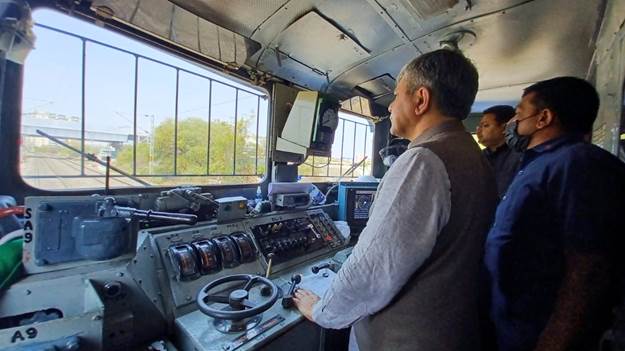
After 678 rail accidents, safety finally gets priority with a Rs 1.3 trillion push

  • | Wednesday | 24th December, 2025

BY- Alok Verma 

Every day, millions of Indians board trains assuming one basic thing—that the system will not fail them. They do not check safety audits or signalling data. They do not ask how often tracks are renewed or whether protection systems are in place. They assume safety is non-negotiable. That assumption is not blind faith; it is dependence. And when governance treats safety as a background issue that dependence quietly turns into risk.

The government is now considering an investment of over ₹1.3 trillion for railway safety in FY27. It is an unprecedented allocation and a strong signal of intent. But it also forces an uncomfortable question: why did safety need 678 rail accidents over the past decade to reach this level of priority? If safety was central to governance thinking, would such a corrective push be required only now?

Official data shows that consequential train accidents have declined over the years. That progress is real and should be acknowledged. Yet public trust does not behave like statistics. One major accident wipes out years of incremental improvement in an instant. For passengers, safety is binary—you are safe until you are not. Numbers offer reassurance to policymakers but confidence collapses for citizens the moment something goes wrong.

This is where governance often misreads the problem. Safety is treated as a technical challenge—something that can be addressed through allocations, files and engineering fixes. In reality, safety is also a credibility issue. Passengers do not judge railways by how much money is sanctioned, they judge them by outcomes.

Much of the renewed focus today is on basics—track renewals, rolling stock maintenance, signalling upgrades. These are not reforms or innovations. They are fundamentals. Yet in Indian Railways, fundamentals have often been handled as periodic projects rather than continuous processes. Maintenance gains urgency after failure. Safety inspections intensify after accidents. This reactive pattern, repeated over decades, lies at the heart of the problem.

At the same time, India’s railway narrative is filled with ambition—faster trains, new corridors, semi-high-speed services and the promise of bullet trains. Speed brings visibility and prestige. Safety brings restraint and discipline. The two must move together but governance attention is rarely equal. Expansion is celebrated. Protection is assumed. When capacity grows faster than safeguards, margins shrink—and railways operate on thin margins every single day.

The slow spread of Kavach, India’s indigenous automatic train protection system, highlights this contradiction. Kavach is often projected as a major safety breakthrough. Yet years after its introduction, it covers only a small portion of the railway network. From a public perspective, the concern is straightforward: if safety technology exists, why is its rollout still limited? Innovation that does not scale fast enough weakens its core purpose—preventing accidents before they happen.

Safety also suffers because it is treated primarily as expenditure rather than value. Budgets can buy equipment but they cannot enforce discipline. Safety becomes real only when daily practices, incentives and accountability structures align around it. If performance is measured largely by expansion, punctuality or cost control, safety will always compete for attention instead of commanding it.

This is why rail accidents in India often trigger familiar responses—committees, inquiries, reports and recommendations—followed by gradual loss of momentum. Lessons are identified repeatedly but they are not embedded permanently into the system. Institutional memory fades once public outrage subsides. The cycle continues until the next failure brings safety back into focus.

The proposed ₹1.3 trillion push can mark a genuine turning point but only if it represents a deeper shift in thinking. Safety must stop being reactive. It must stop relying on tragedy to gain relevance. It must become instinctive governance—built into everyday decision-making not activated after lives are lost.

The real question is not whether India can afford safer railways. It is whether governance can make safety a priority before accidents force its hand not after. Until that happens, even the largest investments will continue to carry the weight of delay.


If You Like This Story, Support NYOOOZ

NYOOOZ SUPPORTER

NYOOOZ FRIEND

Your support to NYOOOZ will help us to continue create and publish news for and from smaller cities, which also need equal voice as much as citizens living in bigger cities have through mainstream media organizations.


Stay updated with all the Delhi Latest News headlines here. For more exclusive & live news updates from all around India, stay connected with NYOOOZ.

Related Articles