
Slow suicide: We are breathing ourselves to death yet don't care
- | Tuesday | 25th November, 2025
By Alok Verma
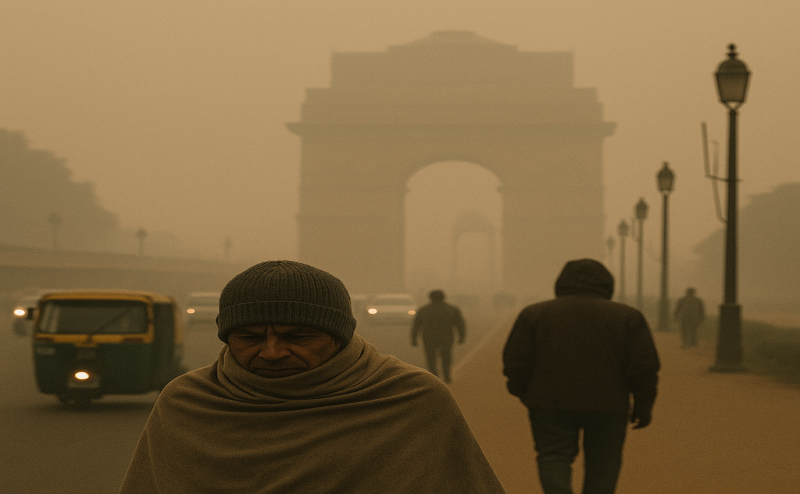
There is something fundamentally disturbing about our behaviour as a society. We are the only country where millions inhale toxic air every day, lose up to eight years of life, watch our children struggle with respiratory illnesses and still go about our lives with shocking indifference. We are not victims of pollution anymore — we are participants in self-harm, addicted to convenience over survival, consumption over caution and recklessness over responsibility.
The tragedy is not just that the air is poisonous. It is that the people breathing it do not seem to mind. India’s citizens are living through the most severe air-pollution crisis in human history. In Delhi-NCR, children as young as ten show 30% reduced lung capacity and hospitals record a seasonal spike of asthma, bronchitis and cardiac emergencies every winter. Yet the average citizen continues to behave like nothing is wrong. Pollution is treated as a seasonal irritant, not a permanent killer. The daily choices of millions — burning garbage, using diesel SUVs for short distances, ignoring waste segregation, allowing dust to fly off construction — collectively form the toxic cloud that now defines urban India.
We are poisoning ourselves
Our consumer habits have turned mindless. We crave convenience, speed, and lifestyle upgrades — but refuse the discipline required to reduce our pollution footprint. We demand clean air, clean water and better public health systems but make no personal corrections when it comes to the environment. We purchase larger vehicles, burn more plastic, leave engines idling, dump waste wherever convenient and shrug when confronted with the consequences. As a society, we want comfort without responsibility.
India today spends billions on pollution-linked health conditions. From respiratory disorders to cardiac complications and cancer risks, the medical cost of living in a polluted city has reached a point where middle-class families struggle to afford basic treatment. The poor, who live closest to garbage dumps, industrial belts and congested traffic corridors suffer the worst. The rich may install air-purifiers at home but even they cannot escape what awaits outside. Toxicity does not recognize class.
Irresponsible corporate sector
India’s industries contribute nearly 30% of PM2.5 emissions, yet many continue to bypass scrubbers, use banned fuels and flout emission standards. Industrial clusters in Ghaziabad, Bhiwadi, Panipat, Ludhiana, and Vapi are among the most polluted in the world. And even as corporations talk endlessly about ESG, net-zero, sustainability and green leadership in their glossy reports, very few invest seriously in reducing actual emissions.
Worse, corporate advertising has normalised high-pollution lifestyles — the aggressive marketing of large diesel SUVs, plastics, crackers and environmentally harmful products continues without any environmental disclosure. There is no warning label, no public messaging, no responsibility. Profit is the priority and the environmental scars are left behind for the nation to absorb.
.jpg)
Government successive failures
Governments — both at the Centre and in the states — have failed to rise above political compulsions. Pollution control has become an annual blame game, not a sustained public-health priority. While policies and action plans exist on paper, implementation remains deeply uneven. Funds remain unspent, enforcement remains weak and political narratives focus on convenience instead of consequences.
The ₹20,000 crore allocated under NCAP, the largest clean-air initiative ever launched in India, remains underutilised in several states. Most polluted cities have only 2–3 functional monitoring stations, making real-time data unreliable. Municipal bodies, responsible for the majority of on-ground pollution management are chronically underfunded, understaffed and structurally incapable of controlling dust, waste burning or construction emissions. Environmental rules are waived for economic convenience and clearances are handed out easily even to high-polluting industries.
How did protecting corporate interests become more important than protecting citizens’ lungs? Beyond cities, India’s natural heritage is collapsing under the weight of neglect. Lakes and ponds have shrunk by 40% in three decades due to encroachment. Mountains once considered pristine now drown under tourist waste. Wildlife habitats suffocate under encroachments, burning fields, garbage and construction. Air pollution is no longer an “urban problem” — it is a national threat, touching rural regions, forests, riversides and hill stations.
Crisis of national character
A society that fails to protect its air shows a deeper moral decay. A government that overlooks long-term public health for short-term political comfort must be questioned. A corporate sector that profits while leaving behind an environmental wound must be held accountable. And citizens who refuse to change must accept that they are complicit in their own suffering.
The question is stark: How long can we continue this slow, collective suffocation before the damage becomes irreversible? India is standing at a dangerous crossroad — where the air we breathe is no longer a medium of life but a reminder of our collective failure. The future of an entire generation is at stake. Medical experts warn that a child born today in India will breathe more toxic air in their first five years than someone living in Europe breathes in forty. This is not the future we promised ourselves.
Clean air is not a luxury. It is the first right of life. And no society that destroys its air can claim to be progressing. If we do not act now — with urgency, discipline and collective responsibility — the next generation will inherit not a nation but a toxic legacy.
(The writer is national award winning senior journalist and founder, Newzstreet Media)

If You Like This Story, Support NYOOOZ
Your support to NYOOOZ will help us to continue create and publish news for and from smaller cities, which also need equal voice as much as citizens living in bigger cities have through mainstream media organizations.
Stay updated with all the Delhi Latest News headlines here. For more exclusive & live news updates from all around India, stay connected with NYOOOZ.