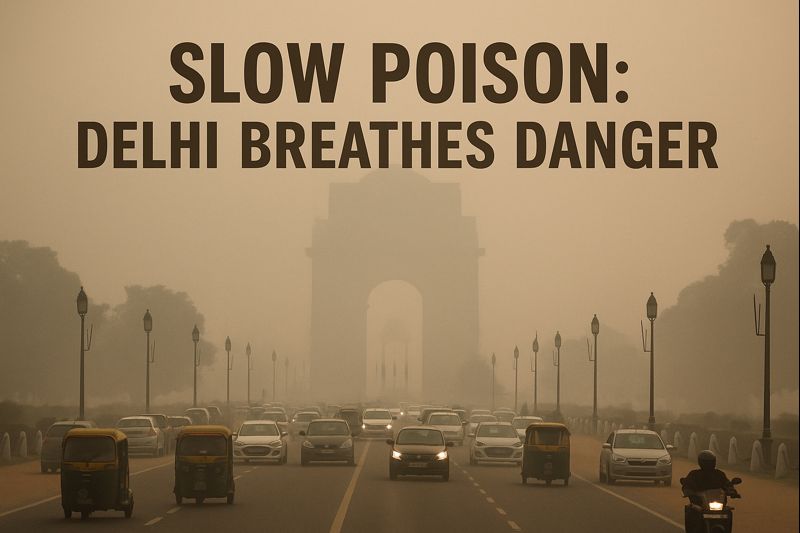
Smog, Smog everywhere, where will you escape ?

  • | Tuesday | 16th December, 2025

BY-Alok Verma

The idea that one can outrun pollution by relocating has become a dangerous myth. For years, Indians troubled by choking air have comforted themselves with a familiar belief: if one leaves Delhi or the NCR and moves to the hills, the coast, or a quieter city, clean air will follow. That belief no longer holds. Recent data shows that pollution has ceased to be a regional problem. It has become national, structural and deeply entrenched. Geography is no longer protection. The difference between cities is now only a matter of degree.

Evidence from across the country over the last year makes this clear. Nearly 60 per cent of India’s districts breach the annual National Ambient Air Quality Standards, and not a single district meets the World Health Organization’s PM2.5 guideline. Coastal towns and high-rainfall regions may record lower averages, but local factors create severe pollution pockets with serious public health consequences. Goa, often imagined as a refuge, has seen hazardous air quality episodes of its own.

Another misconception needs correction: that air pollution is primarily a Delhi or NCR affliction. Delhi is undoubtedly among the worst-hit, but it is far from alone. In recent weeks, Kolkata’s air quality has been worse than Delhi’s on several days. Cities like Patna, Lucknow, Ahmedabad and Chandigarh have recorded persistently poor air. In Gujarat, Raikhad touched an AQI of over 300, with nearby towns not far behind. What distinguishes Delhi is not exclusivity, but visibility. The rest of urban India suffers largely outside the national spotlight.

Smog Without Borders

The spread of pollution is no longer confined to traditional hotspots. Data shows clusters of severely affected districts across Rajasthan, Haryana, Uttar Pradesh, Bihar, Madhya Pradesh, Odisha and West Bengal. Even the North-East, long considered relatively clean, is losing that distinction. Districts in Assam, including industrial and mining belts, have seen thick smog episodes, exposing how decades of unchecked activity eventually overwhelm even regions once thought resilient. Smog is no longer seasonal, nor local. It has become a daily, nationwide reality.

This crisis is not an accident. Civil society must share responsibility. Our dependence on private vehicles, tolerance of waste burning, acceptance of dust-laden construction, and unwillingness to change daily habits have all contributed to the problem. We demand clean air, but resist any measure that inconveniences us. Behavioural change is endlessly postponed, while the consequences accumulate silently in lungs, hospitals and mortality statistics.

Yet the greater culpability lies with governments and policymakers. Across parties and states, air pollution is treated as a political inconvenience rather than a public health emergency. Tough decisions are deferred because they risk upsetting specific voter blocs. Restrictions are imposed briefly during peak crises and quietly withdrawn. Children and the elderly, the most vulnerable, rarely shape policy urgency. The question that remains unanswered is stark: what kind of future is being built when health is repeatedly subordinated to electoral calculations?

A Crisis Worse Than the Data Admits

Even the grim picture presented may be understated. India’s air quality monitoring infrastructure is inadequate and unreliable. The number of monitoring stations is insufficient for the country’s size, and some remain offline for extended periods due to administrative failures such as unrenewed maintenance contracts. In Haryana, all monitoring stations were shut for months for precisely this reason. When data collection itself is compromised, under-reporting becomes systemic.

The absence of accurate, granular data allows complacency to thrive. If pollution levels appear lower on paper, urgency diminishes in practice. But polluted air does not disappear because it is poorly measured. The reality on the ground is likely worse than official figures suggest, especially in smaller cities that rarely attract national attention.

India’s air pollution crisis is no longer about one city, one season, or one policy failure. It is the cumulative result of collective irresponsibility, political hesitation and institutional neglect. Smog is everywhere, and so is accountability. Ignoring it will not make it fade. It will only ensure that the cost is paid by those with the least voice — today’s children and tomorrow’s citizens.


If You Like This Story, Support NYOOOZ

NYOOOZ SUPPORTER

NYOOOZ FRIEND

Your support to NYOOOZ will help us to continue create and publish news for and from smaller cities, which also need equal voice as much as citizens living in bigger cities have through mainstream media organizations.


Stay updated with all the Delhi Latest News headlines here. For more exclusive & live news updates from all around India, stay connected with NYOOOZ.

Related Articles