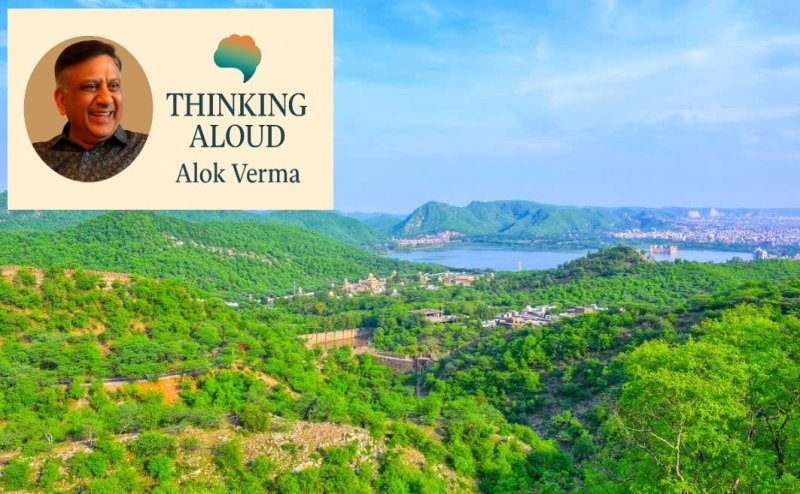
Aravallis under threat & Air unbreathable: A crisis of environmental misgovernance

  • | Friday | 26th December, 2025

BY-Alok Verma

The agitation around the Aravalli hills is not a reaction to one technical top court`s decision. It reflects a deeper loss of trust in environmental governance. The recent acceptance by the Supreme Court of India of a revised definition of the Aravallis has triggered concern because people have seen for years how environmental protection often collapses on the ground.

Mining in the Aravalli region has been restricted or banned in different forms for more than two decades. Yet illegal mining continued in parts of Haryana and Rajasthan. Hills were cut, forests damaged, groundwater depleted and land converted for construction. Enforcement followed in cycles. FIRs were filed, machinery seized and committees formed. Convictions remained rare. Deterrence remained weak. Over time a pattern became obvious. Rules existed. Violations continued. Accountability was missing.

This history explains the public response today. Trust in environmental policy is built on outcomes, not intent. When people repeatedly see the same hills being mined despite bans and court orders, confidence erodes. Any new definition is then viewed with suspicion. Not because people oppose regulation but because experience tells them that loopholes are often exploited.

The Aravallis are not just a collection of peaks measured by height. They function as a connected ecological system. Their lower ridges, scrub forests, slopes and catchment zones hold soil, recharge groundwater and block desert dust. These features matter as much as the higher hills. When they are disturbed the impact does not stay local.

This is where the Aravalli debate links directly to India’s worsening air pollution.

Rising AQI levels across North India, especially in the Delhi–NCR region, are often treated as seasonal or urban problems. In reality they reflect long-term ecological damage. Exposed hills, degraded land and shrinking green buffers release dust. That dust turns into particulate pollution. What appears in files as mining or land-use change finally appears as PM10 and PM2.5 in the air people breathe.

Air pollution has become the most visible sign of environmental policy failure. Despite clean air plans, court directions and emergency measures, air quality has continued to worsen. Schools shut. Hospitals fill up. Respiratory illness becomes routine. For citizens this daily experience matters more than official assurances. When outcomes do not improve, belief weakens.

The beneficiaries of regulatory ambiguity are not difficult to identify. Mining operators, land developers, transporters and traders have repeatedly taken advantage of grey zones. Political and administrative patronage has often protected them. This protection has crossed party lines over the years. The costs however are borne by ordinary people. Workers breathe toxic air. Farmers face falling water tables. Children grow up with asthma. The elderly struggle through polluted winters.

Environmental ambiguity does not affect everyone equally. It concentrates profit among a few and spreads damage across society.

This explains why environmental anger today feels sharper and wider. It is no longer limited to activists or experts. Pollution has entered homes, bodies and hospital wards. Environmental damage is no longer distant or abstract. It is immediate and personal.

The government argues that uniform definitions bring regulatory clarity. That argument has logic. Administrations need clear criteria to govern land and mining. But clarity alone does not solve the problem. In a system where enforcement has failed repeatedly, definitions are only as strong as the institutions applying them.

Without transparent mapping, clearly declared inviolate zones, independent monitoring and visible punishment of violators, assurances carry little weight. Past experience shows that legal and administrative gaps are quickly identified and used by those with access and influence.

This is why people hesitate to believe that safeguards will hold. The burden of proof does not lie with citizens. It lies with the state to show that protection will be enforced.

The agitation around the Aravallis is not anti-court or anti-development. It reflects a long record of environmental promises that did not prevent damage. Until enforcement becomes consistent and credible, every policy change will be viewed through the lens of past failure.

The Aravalli controversy and the pollution crisis are not separate issues. They are part of the same story. Environmental governance lost credibility. The common citizen paid the price with health and quality of life.

That is the real crisis behind the debate.


If You Like This Story, Support NYOOOZ

NYOOOZ SUPPORTER

NYOOOZ FRIEND

Your support to NYOOOZ will help us to continue create and publish news for and from smaller cities, which also need equal voice as much as citizens living in bigger cities have through mainstream media organizations.


Stay updated with all the Delhi Latest News headlines here. For more exclusive & live news updates from all around India, stay connected with NYOOOZ.

Related Articles