When 'Me' becomes bigger than 'We': Is India losing its social conscience?

  • | Tuesday | 14th July, 2026

Article 1 of 3 part series BY-Alok Verma  

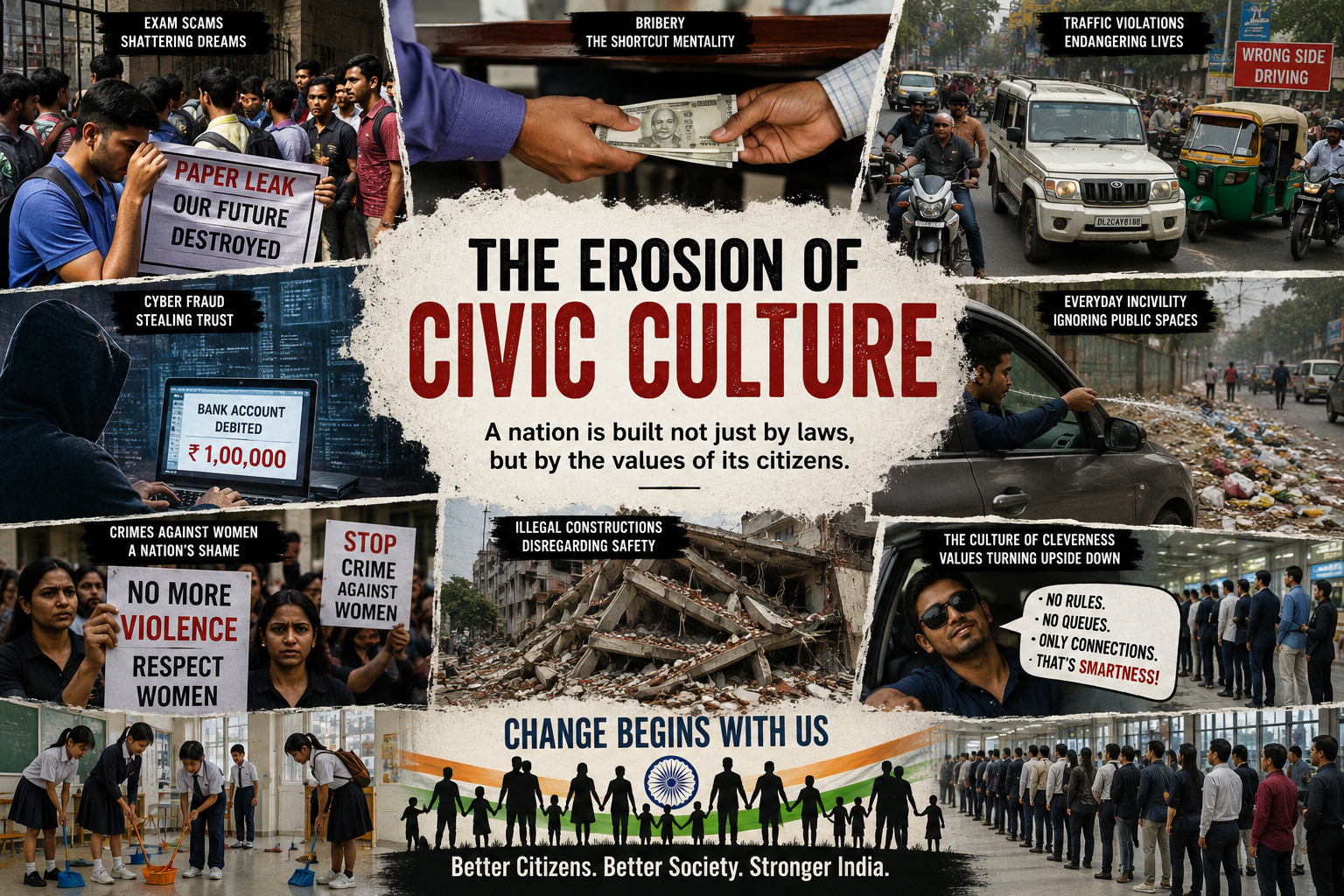
Every day, India`s newspapers and television channels report incidents that appear to have little in common. A recruitment examination is cancelled after a paper leak destroys the aspirations of thousands of deserving students. A government official is caught accepting a bribe. Videos of motorists driving on the wrong side of busy roads while threatening those who question them go viral. Cybercriminals defraud unsuspecting families of their life savings. A woman becomes the victim of another brutal crime. An illegal building collapses because safety standards were compromised. Read individually, these are stories of crime, negligence or misconduct. Read together over weeks and months, they begin to resemble something larger. They force us to ask whether these are merely isolated failures of individuals or whether they reflect a gradual erosion of India`s civic and moral culture. It is an uncomfortable question but one that can no longer be ignored by a society aspiring to become one of the world`s leading economic powers.

Interestingly, this concern is no longer based merely on anecdotal observation. The recent India Today Gross Domestic Behaviour Survey, conducted across 98 districts with over 9,000 respondents, attempted to examine something that GDP, stock market indices and economic surveys cannot measure—the everyday behaviour of citizens. One of its most striking findings was that while an overwhelming majority of respondents opposed corruption, tax evasion and civic violations in principle, nearly sixty-one per cent admitted they would willingly pay a bribe if it expedited their work. That contradiction captures the dilemma confronting contemporary India. We understand the difference between right and wrong, yet when personal convenience, financial gain or social advantage is involved, our actions often depart from our professed values. The issue, therefore, is not ignorance. It is the growing gap between what we know and what we choose to practice.

Perhaps the most disturbing development is not the increase in spectacular crimes but the normalization of everyday incivility. There was a time when certain acts invited immediate embarrassment because society instinctively regarded them as unacceptable. Today many no longer do. Men openly urinate on public walls despite women and children passing by. People spit tobacco from moving vehicles onto roads and footpaths without a moment`s hesitation. Loud expletives are casually used in crowded public places with little regard for families or children nearby. Triple riding on motorcycles, jumping traffic signals, overtaking from the wrong side, driving against the flow of traffic and routinely ignoring basic safety norms have become so common that they barely attract attention. Even aboard aircraft, despite repeated announcements by the cabin crew requesting passengers to remain seated until the aircraft comes to a complete halt and the doors are opened, a large number of educated passengers immediately stand up, crowd the aisles and pull down luggage from overhead bins as though waiting another minute would impose an unbearable hardship. These are not acts committed because people are unaware of the rules. They are conscious choices made by educated and informed citizens. What appears to have changed is not our knowledge of right and wrong but the gradual disappearance of social embarrassment associated with doing the wrong thing.

This shift deserves far greater attention than it receives. Every civilization ultimately rests on an unwritten social contract. Laws, police and courts are important but they cannot regulate every aspect of public behaviour. Civilized societies function because citizens voluntarily restrain themselves even when no one is watching. They obey traffic rules not merely because a traffic constable is present but because they recognize that those rules protect everyone. They queue because they respect another person`s time. They avoid littering because public spaces are regarded as a shared responsibility rather than somebody else`s problem. Once this moral restraint weakens, the burden on institutions becomes impossible to bear. No government, however efficient, can police every street corner, every marketplace or every neighbourhood if society itself ceases to value self-discipline.

Equally troubling is the gradual celebration of what might be called the culture of cleverness. Increasingly, the individual who manipulates the system is admired as "smart". The person who secures favours through political influence is considered "well connected". Queue-jumping is viewed as resourcefulness, tax evasion as financial intelligence and paying a bribe as an efficient way of getting things done. Somewhere along the way, cleverness has begun replacing character as a social virtue. This changing mindset also influences our understanding of success. There is nothing wrong with ambition or with wealth honestly earned. India`s remarkable economic transformation has created opportunities unimaginable a generation ago. Yet prosperity without responsibility creates its own distortions. Bigger houses, multiple properties, luxury vehicles, designer brands and extravagant displays of wealth increasingly become measures of social worth, while questions about integrity, fairness and public responsibility recede into the background. Success is applauded, but the means by which it is achieved often attract far less scrutiny than they deserve.

The consequences of this changing social mindset are visible in recurring examination scams, financial frauds, illegal constructions, food adulteration, environmental violations and corruption that continue to surface with disturbing regularity. Official data continue to record hundreds of thousands of crimes against women every year, while cybercrime has expanded rapidly with the growth of the digital economy. These figures should not be interpreted as evidence that India lacks values or compassion. On the contrary, India repeatedly demonstrates extraordinary generosity whenever disasters strike. During floods, earthquakes, accidents and the pandemic, countless citizens volunteered, donated blood, organized community kitchens and risked their own lives to help complete strangers. Compassion clearly survives in Indian society. The paradox is that extraordinary generosity during moments of crisis coexists with a striking indifference to everyday civic responsibility. We often rise magnificently in exceptional situations while failing to observe the small disciplines that make civilized public life possible.

Many Indians who travel abroad return with remarkably similar observations. Countries such as Japan, South Korea, Vietnam and Thailand are by no means free from crime, political controversies or social problems. Yet their public spaces often function differently because civic behaviour is reinforced not only by law but by powerful social expectations. In Japan, children clean their own classrooms from an early age, learning that public spaces belong to everyone. Speaking loudly on trains, littering or cutting queues attracts silent but unmistakable social disapproval. In South Korea, civic discipline is reinforced through schools, dense urban living and strong peer expectations. Visitors to Vietnam and Thailand similarly notice orderly public conduct in many cities, not because those societies are flawless but because discourteous behaviour carries a social cost. The comparison is not intended to romanticize other countries or diminish India. It simply raises a legitimate question. Why do such behaviour that invite embarrassment elsewhere so often attracts indifference—or even admiration—here?

Reversing this trend cannot be left to governments alone. Governments can enact laws, improve infrastructure and strengthen enforcement, but they cannot legislate courtesy, manufacture civic responsibility or create empathy. That responsibility belongs equally to families, schools, community organizations, religious institutions, the media and every citizen. Civic education must begin early and be practiced daily rather than confined to textbook lessons. Public behaviour that inconveniences others must once again invite social disapproval rather than silent acceptance. Rules must apply equally to everyone, regardless of status or influence, because selective enforcement weakens respect for the law itself. Above all, we must recover the belief that public spaces belong to all citizens and that safeguarding them is a shared responsibility rather than a government obligation alone.

India`s aspiration to become a developed nation is both legitimate and inspiring. But the true test of development will not lie only in GDP, expressways, airports, digital infrastructure or global economic rankings. It will lie equally in the everyday conduct of ordinary citizens—in whether we obey rules when no one is watching, respect strangers as fellow citizens, protect public spaces as carefully as private property and place the common good above momentary personal convenience. History reminds us that great nations rarely decline because they exhaust their wealth. They weaken when they gradually cease to value the principles that once held society together. As India moves confidently towards a larger global role, perhaps the most important question before us is not how prosperous we will become, but whether we can rebuild the civic culture that makes prosperity meaningful. For the future of India will ultimately be shaped not only by what we build, but by what we become.

(The writer is a national award-winning senior journalist and founder Newzstreet Media)


If You Like This Story, Support NYOOOZ

NYOOOZ SUPPORTER

NYOOOZ FRIEND

Your support to NYOOOZ will help us to continue create and publish news for and from smaller cities, which also need equal voice as much as citizens living in bigger cities have through mainstream media organizations.


Stay updated with all the Delhi Latest News headlines here. For more exclusive & live news updates from all around India, stay connected with NYOOOZ.

Related Articles