Before we judge Gen Z, are we willing to put the generation that raised them in the witness box?

  • | Saturday | 25th July, 2026

The real question is: What has happened to the India that Gen Z inherited? BY Alok Verma

That question has been troubling me ever since India witnessed one of the most remarkable youth mobilizations in recent memory.

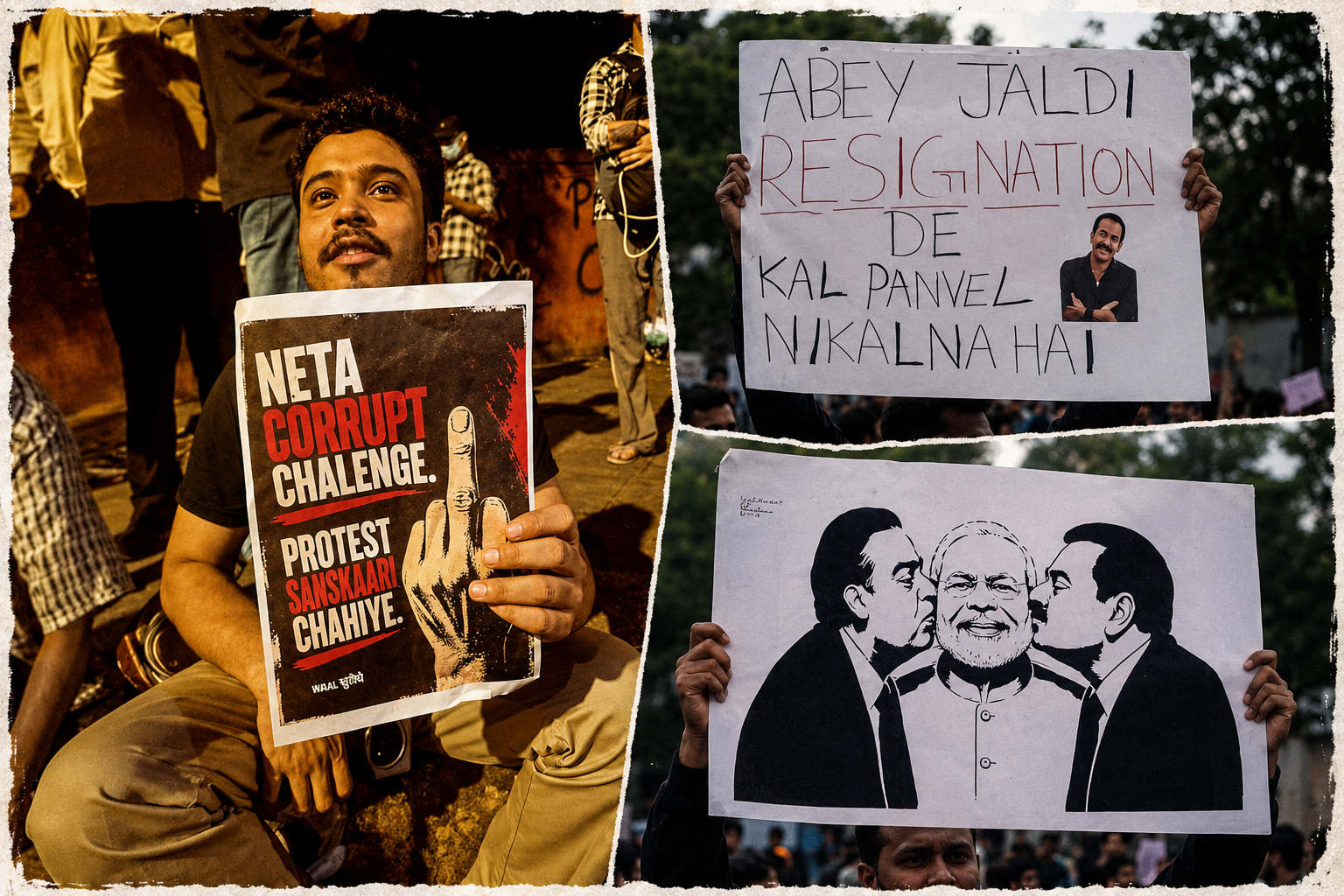
Every older generation eventually reaches a point where it begins complaining about the one that follows. We call the young impatient, entitled, disrespectful and irresponsible. My generation has now begun doing the same to Gen Z. Over the past few days, sections of television media, journalists, editors, political commentators and social media have gone much further. Protesting students have been labelled anti-national, politically manipulated, disruptive and even agents of hostile interests. Their anger has been mocked, their language condemned and their character put on trial.

Before we pronounce judgment on an entire generation, however, we owe them something far more difficult than criticism. We owe them an honest examination of ourselves.

What began as outrage over the alleged NEET paper leak and the demand for the resignation of then Union Education Minister Dharmendra Pradhan rapidly outgrew the boundaries of an examination controversy. Students came onto the streets and were soon joined, in spirit and often in person, by parents who had invested years of sacrifice in their children’s education, professionals, public intellectuals, artists and countless ordinary citizens who sensed that something much deeper was unfolding. The government’s reluctance to acknowledge the depth of the grievance, followed by police action against protesters and the forcible removal of Sonam Wangchuk from his hunger strike, transformed a student movement into a national moral moment. By the time the Minister resigned, the agitation had become a referendum on trust.

Many commentators looked at the movement and asked, What is wrong with Gen Z?

I believe they were asking the wrong question. The real question is: What has happened to the India that Gen Z inherited?

A paper leak, by itself, does not bring an entire generation onto the streets. It merely ignites frustration that has been building for years. India’s young have grown up amid repeated examination irregularities, delayed recruitments, rising educational costs, uncertain employment, the disruptive impact of artificial intelligence and a shrinking confidence that merit alone can secure opportunity. Behind every student stands a family that has invested its savings, postponed dreams and pinned its hopes on education. When the system repeatedly fails, anger is not irrational. It is inevitable.

Yet, as the movement gathered momentum, sections of the mainstream media quietly shifted the national conversation. Instead of asking why so many young Indians had abandoned classrooms and coaching centres to occupy the streets, the spotlight moved to the protesters themselves. Their language, clothing, hairstyles and placards became prime-time subjects of debate. Institutional failure was pushed aside by a debate over youthful behaviour.

But Gen Z belongs to the first generation in Indian history that does not depend upon television to narrate its story. Armed with smartphones and social media, it documented events in real time, challenged selective narratives and placed its own evidence before millions. For perhaps the first time, mainstream media discovered that it no longer possessed a monopoly over public truth.

Even then, we still have not answered the central question. Why did this generation respond with such intensity? The answer, I believe, lies not in Gen Z but in us. We taught one set of values and rewarded another.

Let me also state my position clearly. There can be no defence for violence, destruction of public property or attacks on police personnel. Equally, there can be no defence for repeated paper leaks, institutional indifference or disproportionate force against peaceful protesters. Democracy demands responsibility from both citizens and the State, but the State carries the higher constitutional obligation because it exercises lawful power.

The criticism most frequently directed at Gen Z concerns its language. Many argue that this generation has lost its civility and values. I believe they are asking the wrong question. Where did Gen Z learn this language? Which generation normalized shouting over reason? Which generation turned political disagreement into personal abuse? Which generation transformed television debates into nightly spectacles of confrontation? Which generation taught that power matters more than persuasion?

Children rarely become what adults teach. They become what adults repeatedly demonstrate.

Every society educates its children twice. The first education takes place in classrooms, homes and textbooks, where we teach honesty, merit, hard work, respect for institutions and integrity. The second education is silent but far more powerful. It unfolds every day before young eyes. Gen Z did not learn about democracy only from civics lessons; it learnt democracy by watching Parliament and State Assemblies. It learnt public ethics by observing political conduct, institutional accountability by dealing with bureaucracy, justice by watching how laws were enforced, professionalism by experiencing schools and universities and citizenship by observing families, businesses, community leaders, the media and every public institution that shapes national life. Every institution became its classroom.

Over the past few months, I have written about India’s shrinking social conscience, our growing obsession with power and the urgent need to rebuild our moral foundations. The present unrest cannot be understood in isolation from that larger decline. It emerged from the society we collectively created. If today’s youth appear impatient, cynical or distrustful, we must ask not merely what has happened to them, but what has happened to us.

The young people who filled the streets may have broken traffic barricades. My generation has broken something far more difficult to repair—trust.

Through years of institutional complacency, declining standards of public conduct, political polarization, uneven governance and moral inconsistency, we gradually allowed confidence in the system to erode. The crisis before us is therefore not simply educational. It is institutional, social and moral. The paper leak merely exposed what had long been weakening beneath the surface.

Gen Z has held a mirror before the Republic. We can either condemn the reflection or correct what it reveals. If governments, political parties, schools, universities, bureaucracies, businesses, the media, families and civil society use this moment for honest course correction, this movement will be remembered not merely as a protest but as a turning point in India’s democratic journey. If we fail to do so, we should not be surprised if future generations raise their voices again—perhaps more forcefully than this one did.

The question before us is not whether Gen Z should become calmer. The question is whether we are prepared to become better.

Because before we judge Gen Z, we must first be willing to put the generation that raised them in the witness box.

(The writer is a national award-winning senior journalist and founder Newzstreet Media)


If You Like This Story, Support NYOOOZ

NYOOOZ SUPPORTER

NYOOOZ FRIEND

Your support to NYOOOZ will help us to continue create and publish news for and from smaller cities, which also need equal voice as much as citizens living in bigger cities have through mainstream media organizations.


Stay updated with all the Delhi Latest News headlines here. For more exclusive & live news updates from all around India, stay connected with NYOOOZ.

Related Articles