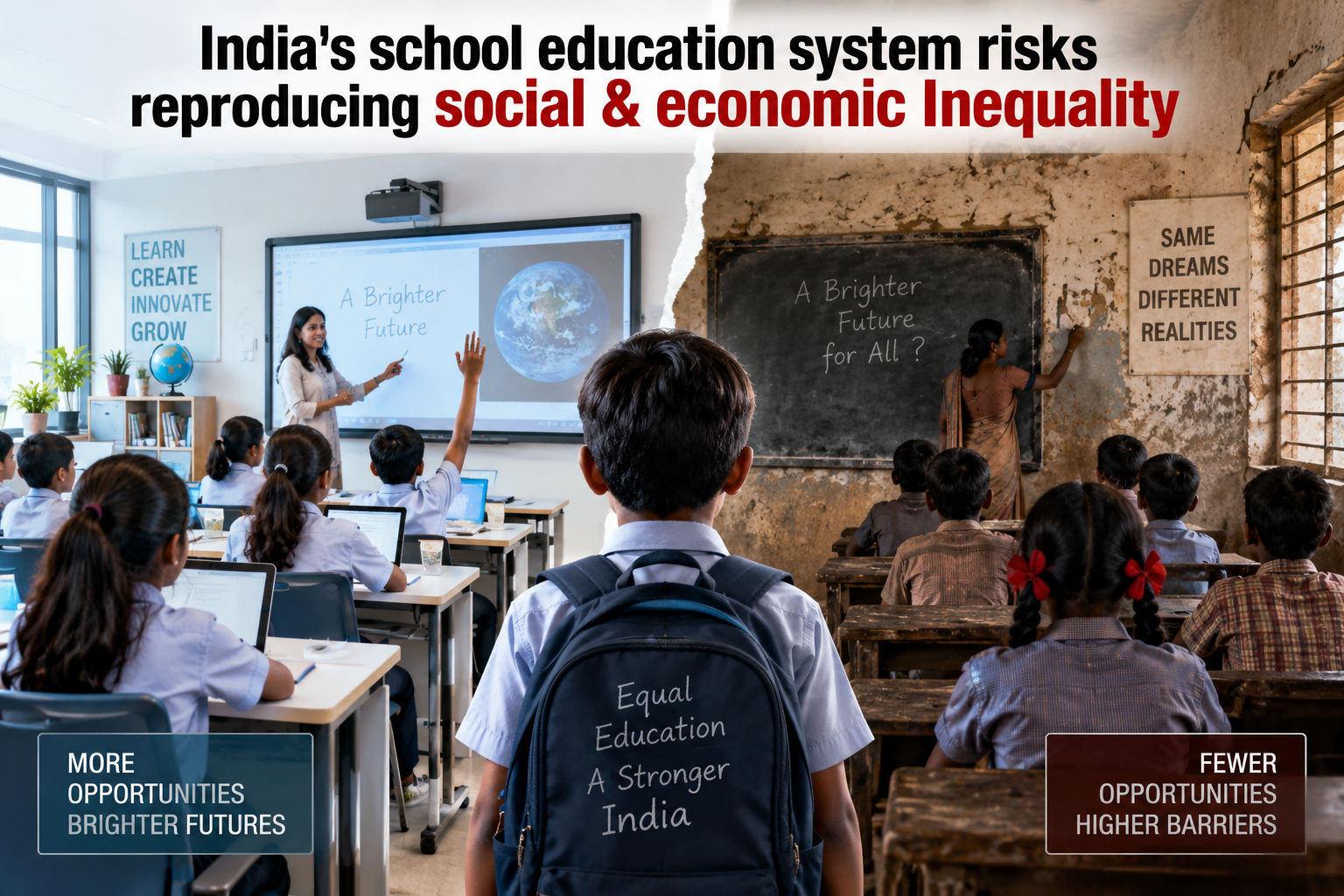
India's school education system risks reproducing social & economic Inequality

  • | Wednesday | 16th September, 2026

BY-Alok Verma    Has it democratized access to educational opportunity?

India has achieved a remarkable transformation in education. Schools have expanded, enrolment has reached near-universal levels at the elementary stage, gender gaps have narrowed and millions of children whose parents had limited access to education are now in classrooms. Yet behind this achievement lies an uncomfortable question: while India has democratized access to schooling, has it democratized access to educational opportunity?

Consider two children entering Class I in the same year. One studies in a well-resourced school with competent teachers, laboratories, technology, strong language exposure and extracurricular opportunities. At home are books, broadband, educated parents and, when necessary, private tuition. Another may attend a school struggling with teachers, infrastructure, technology or academic support, while the family lacks the resources to compensate for what the school cannot provide. Both are counted equally in India`s enrolment statistics. Twelve years later, both may possess Class XII certificates. But have those twelve years prepared them equally for adulthood?

This is the uncomfortable reality behind India`s educational progress. We do not really have one educational India. We have multiple educational Indias operating simultaneously.

The divide is not simply government versus private. India has excellent government schools and poor private ones. The fault lines run across metropolitan and small-town India, urban and rural communities, affluent and low-income households and well-functioning and poorly resourced schools. The Government`s Comprehensive Modular Survey: Education 2025 found that 55.9 per cent of students nationally attended government schools. In rural India the figure was 66 per cent; in urban India, only 30.1 per cent. These children are growing up within very different educational environments.

The inequality becomes deeper beyond the school gate. Education today is not produced by schools alone. Families with resources construct a second educational ecosystem around their children—private tuition, coaching, computers, broadband, books, English-language exposure, competitive-examination preparation, sports and extracurricular experiences. The same government survey found average household expenditure of ₹2,863 per student in government schools against ₹25,002 in non-government schools. This does not prove a corresponding difference in quality because government education is subsidized but it demonstrates different private resources surrounding children`s education. Significantly, 27 per cent of school students were taking or had taken private coaching.

These differences matter because educational advantage multiplies. Strong reading improves comprehension; comprehension makes subsequent learning easier. Digital exposure builds familiarity with an increasingly digital world. Debate, sports and cultural activities strengthen communication, teamwork and confidence. Educated parents can help children navigate subjects, examinations, universities and careers. Advantage accumulated at eight can become capability at eighteen.

Disadvantage can multiply too. A child falling behind in reading may later struggle with mathematics and science expressed through increasingly complex language. Limited digital exposure becomes consequential when education and employment become technology-dependent. Poor communication can suppress confidence even where intelligence and potential are abundant.

By 18, therefore, inequality may no longer appear merely in examination marks. One young Indian may possess strong language proficiency, digital fluency, communication skills, analytical ability, confidence and competitive preparedness. Another may possess a formally similar certificate but considerably less of this educational capital. Yet both will compete for the same university seats, professional courses, internships and jobs.

They may be equal on the application form. They are not necessarily equal at the starting line.

This strikes at education`s most important democratic promise. Education should not weaken the relationship between where a child is born and strengthen where that child can eventually reach. But if family circumstances substantially determine educational opportunity, an alarming cycle emerges: economic circumstances influence the educational ecosystem; the ecosystem influences capability; capability affects higher education and employment; employment determines income; and income then shapes the educational opportunities available to the next generation.

Economic advantage can therefore produce educational advantage, which becomes capability advantage and subsequently further economic advantage. For disadvantaged families, the cycle can operate in reverse. Education, instead of consistently functioning as India`s great ladder of social mobility, risks reproducing some of the inequality it was expected to overcome.

The consequences extend beyond income. Young Indians raised within radically different educational worlds can eventually enter radically different social and economic worlds. One group may experience institutions as accessible and opportunity as achievable; another may discover that twelve years of formal schooling have still left many opportunities beyond reach. Persistent inequality of opportunity can eventually weaken confidence in institutions, reduce social mobility and deepen divisions within society. What begins as an educational divide can become an economic divide and ultimately, a challenge to social cohesion.

The policy response cannot be to make every Indian school identical nor should the debate deteriorate into government versus private education. India needs something more fundamental: a credible national floor of educational capability.

A young person completing twelve years of schooling—whether in Delhi, a district town, a tribal community or a remote village—should emerge with assured literacy and numeracy, language competence, scientific reasoning, digital fluency, communication ability, critical thinking and sufficient confidence to participate meaningfully in higher education, employment and civic life.

India`s first educational revolution was about access—putting children into schools. The next must be about capability: ensuring that the occurrence of birth does not determine what twelve years of schooling enable a child to become.

Because if the quality of a child`s educational opportunity continues to depend heavily on geography, purchasing power and family circumstances, we must confront a larger question: can education still perform its greatest democratic function—giving every child a reasonable possibility of transcending the circumstances of birth?

(The writer is a National award winning journalist & founder Newzstreet Media)


If You Like This Story, Support NYOOOZ

NYOOOZ SUPPORTER

NYOOOZ FRIEND

Your support to NYOOOZ will help us to continue create and publish news for and from smaller cities, which also need equal voice as much as citizens living in bigger cities have through mainstream media organizations.


Stay updated with all the Delhi Latest News headlines here. For more exclusive & live news updates from all around India, stay connected with NYOOOZ.

Related Articles