India's primary education crisis: Children are in schools but are they desirably learning ?

  • | Monday | 12th October, 2026

BY- Alok Verma

When Tata Trusts Chairman Noel Tata, in a conversation with Republic TV`s Arnab Goswami, expressed concern about weaknesses in India`s primary education and the foundations being laid for children`s learning, he raised a question that deserves national attention. Can India aspire to excellence in secondary education, higher learning and professional skills when substantial numbers of children fail to acquire essential competencies during their formative years? His concern points to a fundamental contradiction: India has expanded access to schooling considerably, but has not ensured that every child receives the foundational education necessary to benefit from subsequent learning.

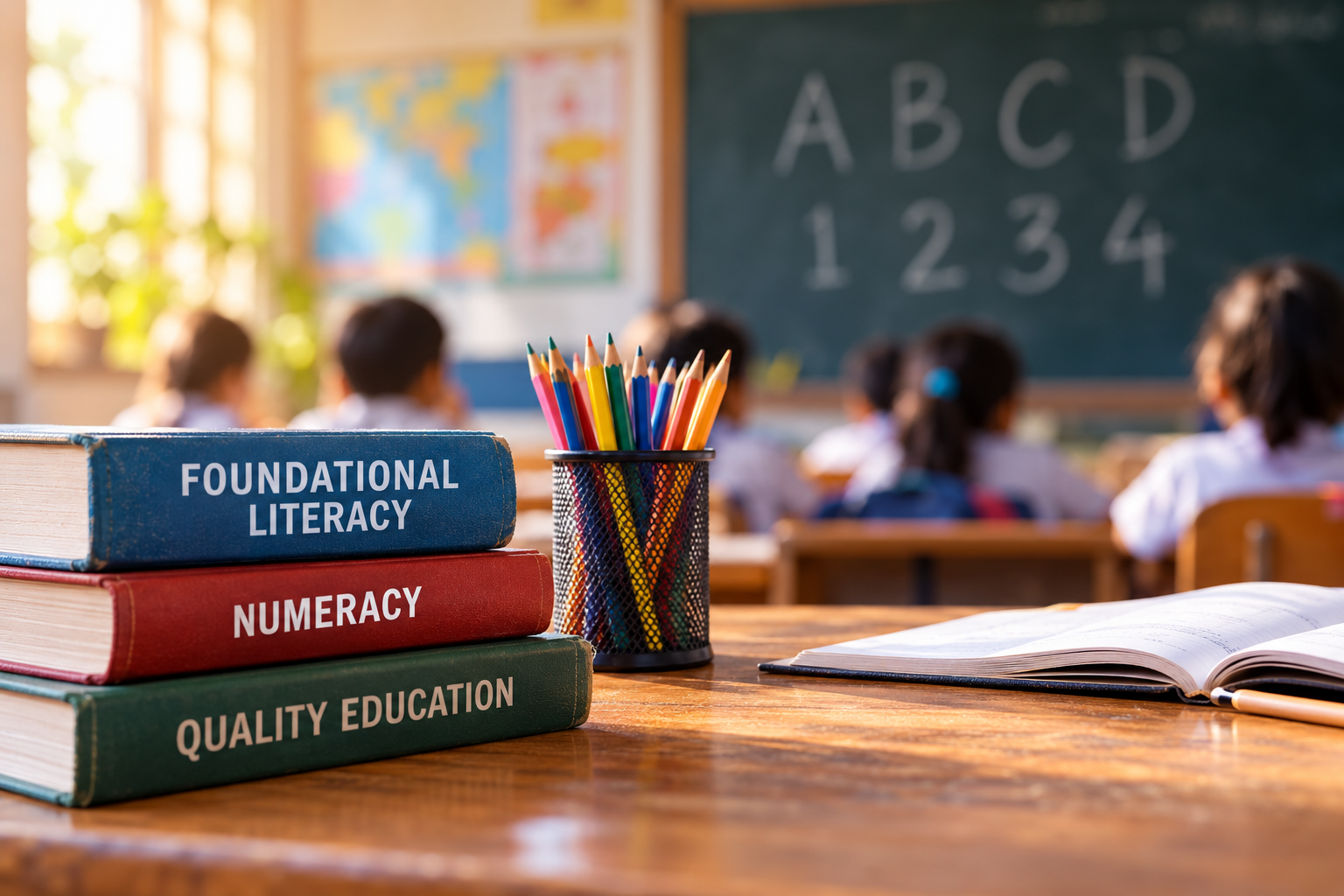
Primary education is not merely the first stage of schooling. It is where children acquire the intellectual tools needed throughout their lives. Reading enables comprehension and independent learning; numeracy develops mathematical reasoning; classroom interaction encourages curiosity, questioning and analytical thinking. These competencies are interconnected. When they are inadequately developed during the early years, children enter higher classes without the preparation required to understand increasingly complex subjects. The deficiencies accumulate, often becoming more difficult to correct with every passing year.

This is the crux of India`s primary education crisis. Despite improvements in enrollment, infrastructure and educational access, foundational learning remains inadequate across large sections of the schooling system. The problem is not restricted to remote villages or government-run schools. It extends into smaller cities and urban educational institutions, although its severity varies. Metro city schools generally enjoy better facilities, educational resources and parental support but these advantages do not automatically ensure strong reading comprehension, numeracy or independent thinking. In rural India, where many schools face additional constraints involving teacher availability, professional preparation and academic support, learning deficiencies are particularly pronounced. Government schools serving disadvantaged communities frequently confront an even greater concentration of these challenges. The real divide, therefore, is not simply between children who attend school and those who do not but between those who acquire essential competencies and those who continue advancing through classes without them.

The Annual Status of Education Report (ASER) 2024 demonstrates the magnitude of these deficiencies. Across rural India, only 48.8 per cent of Class V children could read a Class II-level text. Among Class III children attending government schools, just 23.4 per cent could meet that benchmark, compared with 35.5 per cent in private schools. By Class V, the corresponding figures were 44.8 and 59.3 per cent. The differences are significant but the more troubling finding is that substantial proportions of children in both categories remain below expected reading levels. NCERT`s PARAKH Rashtriya Sarvekshan 2024 also identifies learning gaps across urban and rural schools, although their relative performance varies by competency. Together, these findings indicate a widespread problem, not one confined to a particular category of school.

The variation across states reinforces the concern. ASER findings show considerable differences in foundational reading outcomes among rural government-school children in Himachal Pradesh, Kerala, Uttar Pradesh and Bihar. Some states have made encouraging progress, demonstrating that improvement is achievable. Nevertheless, even comparatively stronger performers have not attained universal foundational competence. The challenge is therefore not merely to expand schooling but to make learning outcomes the principal measure of its effectiveness.

My own experience as a member of the governing board of Chinmaya Vidyalaya, Unchahar, has brought me face to face with the institutional difficulties underlying this national concern. Even in an established school with qualified teachers, prescribed curricula and an administrative structure, ensuring that children acquire expected competencies requires sustained attention. The real challenge is establishing whether classroom teaching produces meaningful learning, whether deficiencies are identified early and whether corrective interventions improve performance. These concerns reflect a larger institutional weakness: academic supervision too often emphasizes syllabus completion and examination performance without adequately establishing what individual children have actually learned.

This leads to the question of classroom pedagogy and teacher preparation. A Tata Trusts-supported Teaching Learning Practices Survey covering 1,050 government-school classrooms across nine states identified limited independent reading opportunities, insufficient use of children`s home languages and weaknesses in individualized feedback. Such practices can encourage mechanical repetition rather than comprehension. Teaching young children to read, reason and learn independently requires specialized expertise yet primary teachers do not consistently receive the professional mentoring, instructional support and recognition that this responsibility demands. Primary teaching must be treated as a specialized discipline, not as a relatively elementary assignment.

Equally important is accountability within schools. Who identifies a child`s learning deficiencies before they become entrenched? Who ensures corrective teaching? Who verifies improvement? Unless principals, academic coordinators and teachers share clearly defined responsibilities for these outcomes, children can progress through successive classes while their foundational weaknesses remain unresolved.

The consequences extend well beyond primary education. A child struggling with comprehension in Class III may find mathematics, science and social sciences increasingly difficult by Class VI. By secondary school, accumulated deficiencies can undermine confidence, academic engagement and examination preparedness. Some children leave school, while others complete formal education without acquiring the capabilities their qualifications should represent. This creates a distinction between physical dropout, learning dropout and capability dropout. The latter two are analytical concepts rather than official classifications, but they capture a serious concern: children may remain enrolled while progressively losing the ability to benefit from education.

India has recognized foundational literacy and numeracy through the National Education Policy 2020 and NIPUN Bharat. The challenge now is to translate policy commitments into classroom outcomes. Primary teachers need specialized preparation and sustained mentoring; schools must identify learning gaps early and provide targeted support; and academic leaders must be accountable for measurable improvement rather than merely attendance, syllabus completion and examination results.

India`s first educational revolution brought children into classrooms. Its next must ensure that those classrooms genuinely educate them. Unless foundational learning becomes the defining priority of primary education, weaknesses established in childhood will continue to compromise the promise of every subsequent stage of education.


(The writer is a senior and national award winning journalist and founder Newzstreet  Media)


If You Like This Story, Support NYOOOZ

NYOOOZ SUPPORTER

NYOOOZ FRIEND

Your support to NYOOOZ will help us to continue create and publish news for and from smaller cities, which also need equal voice as much as citizens living in bigger cities have through mainstream media organizations.


Stay updated with all the Delhi Latest News headlines here. For more exclusive & live news updates from all around India, stay connected with NYOOOZ.

Related Articles