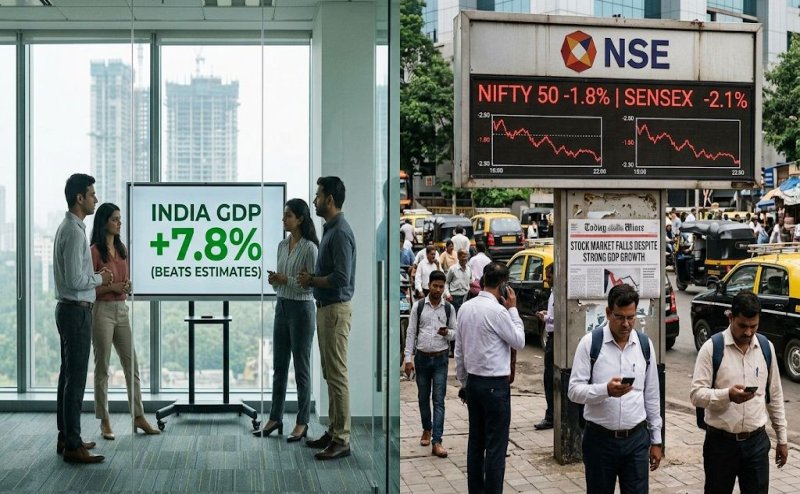



Strange Paradox: The Generation India Has Chosen Not to Use Has What the Young Need
- Wednesday | 9th September, 2026
Vote for BJP in urban local bodies" poll for "triple engine" govt in UP: Adityanath
UP: Man booked for attempting to rape 5-year-old girl
Congress to mark 100 days of Bharat Jodo Yatra with concert in Jaipur
BJYM, Hindu outfits put off planned protest march at AMU
Karachi battles gas crisis; residents face unannounced load shedding, 2-hr gas supply in a day
Elderly man in judicial custody dies during treatment in UP hospital
Himachal Pradesh skittle Haryana for 46, take 200-run lead on Day 1
Pak court grants protective bail to PM Shehbaz"s son Suleman in money laundering case
British Library celebrates India ties with exhibition on Hampi
Nine policemen suspended after suspect dies in police custody in UP
Gangster"s property attached in UP"s Pratapgarh district
Maoists torch construction company vehicles in Jharkhand’s Chatra district
Sino-India border situation "generally stable": China on Yangtse clash
Babar Azam not taking advice from seniors, claims Shahid Afridi
Qlite Global launches their exclusive Grand Experience Centre
"Disillusioned with central leadership": Sikkim BJP president says he has resigned
2001 attack anniversary: Ready to guard new Parliament if directed, say CRPF heroes
Class 2 student dies after scuffle with fellow students in UP
Three killed in accident in UP"s Lakhimpur KheriLakhimpur Kheri (UP), Dec 13 (PTI) Three motorcycle borne youths were killed and "
Abandoned girl child from Assam adopted by Spanish professor
By Animesh Ikshit
New Delhi: India has officially surpassed China in total population. As fertility rates stabilize and the workforce gradually ages over the coming decades, this window of opportunity will inevitably close. To avoid slipping into a stagnant middle-income trap, the country’s strategic focus must pivot away from subsistence-level welfare models and divisive identity politics (such as caste and religious vote-bank considerations). Success must be redefined as building an export-driven, technologically self-reliant industrial superpower. Achieving this demands that we confront and clear the core operational, technological, and structural bottlenecks across our critical sectors: Defence, Automotive Manufacturing, Semiconductors, Infrastructure, and Regulatory Reform.
India`s Trajectory
Moving beyond subsidised grain schemes and basic safety nets prevent acute poverty, as they are baseline duties, not indicators of superpower status. Nation needs a pragmatic, growth-oriented framework prioritizing aggressive industrialisation, export expansion, high-tech manufacturing, and continuous capital generation. Youth expects Modernising higher education toward high-tech execution (AI, advanced robotics, semiconductor design) and developing domestic sectors—such as tourism and sports—into major revenue drivers for GDP. Upgrading, Tier-2 and Tier-3 manufacturing clusters, dedicated freight corridors, and deep-sea ports to integrate directly into global supply networks. Any more regional caste and religious divisions will defer measurable national progress. Demographic advantages are strictly time-bound. India must build fixed industrial capital and high-value productivity before population aging takes hold. Industrial scale directly underpins military capacity, technological independence, and diplomatic weight on the world stage.
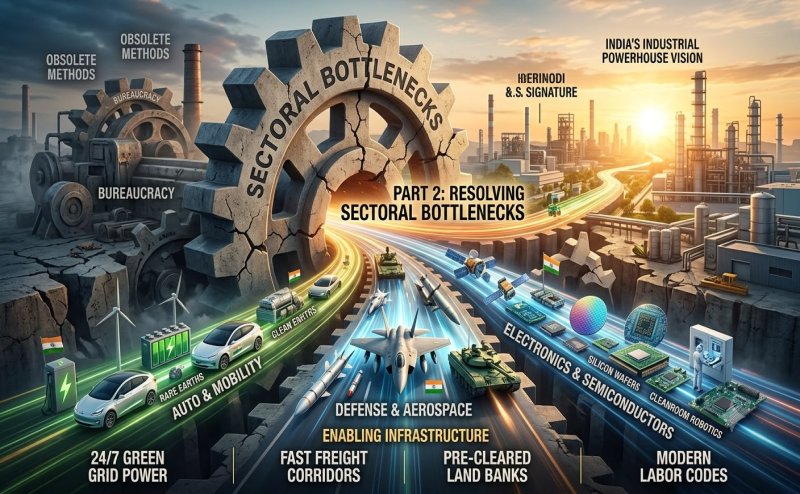
Resolving Sectorial Bottlenecks
Defence Manufacturing & Aerospace
Demand and Execution: Although domestic defence production reached a record ₹1.78 lakh crore in FY26, large order books carry severe delivery risks. Major manufacturers face order book-to-revenue multiples of 1.71x to 6.88x, leaving execution backlogs of 2 to 7 years (and up to 10 years in critical segments). While 76% of production remains tied to public-sector entities, execution—not demand—is the primary hurdle. Low corporate R&D investment leaves domestic firms reliant on imported designs, while high domestic capital borrowing costs discourage deep innovation. Prolonged approval cycles under standard procurement frameworks create revenue uncertainty for private investors.
Automotive Manufacturing & Advanced Mobility
India`s auto component market expands at an estimated 14.8% CAGR toward $132+ billion opportunities, yet deep dependencies persist. China alone accounts for approximately 36% of all auto component imports, while global chip shortages historically disrupted production for over 30% of high-end models. Expand Production-Linked Incentives (PLI) to prioritize deep-tier component localization (shortening development cycles by up to 20%), domestic lithium-ion cell processing, and local electronic control unit (ECU) manufacturing.
Workforce Up skilling for EV/Software-Defined Vehicles: Traditional automotive assembly mechanics are unequipped for the rapid shift toward software-defined electric and hybrid architectures (connected mobility integration has surged by 35% in new car variants). Establish industry-led vocational training centres focused on high-voltage systems, battery chemistry, mechatronics, and embedded automotive software.
Logistics & EV Charging Infrastructure: Elevated freight costs and sparse public fast-charging networks hinder rapid EV adoption and lower export competitiveness. Construct dedicated industrial freight corridors linking auto clusters directly to automated ports, while standardising battery-swapping protocols for commercial fleets.
Semiconductors, Microelectronics & Electronics Manufacturing
The domestic semiconductor market is projected to grow from ~$38 billion in 2023 to $100–$110 billion by 2030. Under the India Semiconductor Mission (ISM 1.0 & 2.0), 10 projects representing ₹1.60 lakh crore in approved investments are underway across six states. However, fabs require massive upfront capital and continuous 24/7 power/water supplies. Build plug-and-play semiconductor parks backed by the ₹8,000 crore ISM outlay for FY26-27, offering dedicated power micro-grids, industrial water treatment, and targeted support for 3nm/2nm roadmap design.
Domestic electronics manufacturing remains vulnerable to supply chain disruptions in silicon wafers, specialty gases, and advanced packaging materials. Secure bilateral critical mineral trade agreements, build chemical-grade processing corridors, and offer targeted subsidies for local semiconductor equipment production.
Specialised Process Engineering Deficits: Despite design talent (with 24+ start-ups backed under DLI schemes attracting ₹430 crore in VC funding), India lacks specialized yield management and packaging engineers. Utilize ISM 2.0`s dedicated workforce funding to establish industry-led research and training centres in VLSI design and micro-actuation.
Logistics, Infrastructure & Utility Realities
Freight Delays & Port Turnarounds: While updated methodologies reflect national logistics costs dropping to ~7.9% of GDP, transit blindness, port bottlenecks, and corridor-specific inefficiencies still disrupt high-precision supply chains. Accelerate PM Gati Shakti integration, digitise port customs clearing, and complete dedicated rail-freight corridors serving high-density manufacturing states.
Energy Reliability for Automated Production: High-precision robotic lines and chip fabs cannot tolerate voltage micro-fluctuations. Provide industrial parks with dedicated micro-grids, utility-scale battery energy storage systems (BESS), and green hydrogen pipelines to ensure stable, low-cost power.
Regulatory Frameworks & Business Climate
Land Acquisition Delays: Securing continuous land parcels for large manufacturing setups remains time-consuming. State governments must establish pre-cleared, environmental-approved land banks complete with utility access before courting private investment.
Labour Code Implementation: Rigid labour compliance frameworks restrict operational flexibility for multi-shift continuous manufacturing. Enforce modernised labour codes that permit flexible shift structures while strengthening social safety nets and formalised apprenticeship programmes.
Judicial Enforcement & Commercial Disputes: Extended timelines in commercial courts increase operational risk for long-term investors. Set up specialized commercial arbitration tribunals dedicated exclusively to handling industrial contract disputes, patent enforcement, and supply chain litigation.
India’s demographic expansion presents a strictly time-bound opportunity. Relying on basic subsistence policies and fragmented vote-bank politics will not secure the country`s economic future. By addressing key execution bottlenecks in defence, automotive manufacturing, electronics, and foundational infrastructure, India can turn its large workforce into an engine for long-term global industrial dominance.

Your support to NYOOOZ will help us to continue create and publish news for and from smaller cities, which also need equal voice as much as citizens living in bigger cities have through mainstream media organizations.