
Strange Paradox: The Generation India Has Chosen Not to Use Has What the Young Need
- Wednesday | 9th September, 2026
Vote for BJP in urban local bodies" poll for "triple engine" govt in UP: Adityanath
UP: Man booked for attempting to rape 5-year-old girl
Congress to mark 100 days of Bharat Jodo Yatra with concert in Jaipur
BJYM, Hindu outfits put off planned protest march at AMU
Karachi battles gas crisis; residents face unannounced load shedding, 2-hr gas supply in a day
Elderly man in judicial custody dies during treatment in UP hospital
Himachal Pradesh skittle Haryana for 46, take 200-run lead on Day 1
Pak court grants protective bail to PM Shehbaz"s son Suleman in money laundering case
British Library celebrates India ties with exhibition on Hampi
Nine policemen suspended after suspect dies in police custody in UP
Gangster"s property attached in UP"s Pratapgarh district
Maoists torch construction company vehicles in Jharkhand’s Chatra district
Sino-India border situation "generally stable": China on Yangtse clash
Babar Azam not taking advice from seniors, claims Shahid Afridi
Qlite Global launches their exclusive Grand Experience Centre
"Disillusioned with central leadership": Sikkim BJP president says he has resigned
2001 attack anniversary: Ready to guard new Parliament if directed, say CRPF heroes
Class 2 student dies after scuffle with fellow students in UP
Three killed in accident in UP"s Lakhimpur KheriLakhimpur Kheri (UP), Dec 13 (PTI) Three motorcycle borne youths were killed and "
Abandoned girl child from Assam adopted by Spanish professor
BY-Alok Verma
India has spent decades celebrating its demographic dividend and worrying about whether its young people have the skills required for a changing economy. Yet, almost unnoticed, another demographic transformation is gathering pace. India is getting older. By 2050, about 346 million Indians—nearly 21 per cent of the population—are projected to be over 60. More strikingly, by 2046, the elderly could outnumber children below 15. India will still have a large young population, but it will simultaneously have to learn how to live with, care for and make productive use of a very large older population.
The problem is that our understanding of ageing has not kept pace with longevity. We still tend to see life through a rigid sequence: education, employment, retirement and dependency. At 58 or 60, a person retires from an organization and almost immediately begins to be classified as a senior citizen. But retirement from employment does not mean retirement from capability. Millions of Indians in their 60s, and many well into their 70s, remain physically active, intellectually alert and capable of contributing meaningfully for years.
What disappears after retirement is often not capability but opportunity. A teacher who has taught thousands of students suddenly has no classroom. A banker carrying decades of financial experience has nobody seeking his advice. Engineers, administrators, defence personnel, doctors, managers, entrepreneurs, journalists and other professionals who spent 30 or 40 years accumulating knowledge can find themselves disconnected from productive life almost overnight. Along with the job go routine, colleagues, responsibility, recognition and the reassuring feeling of being needed.
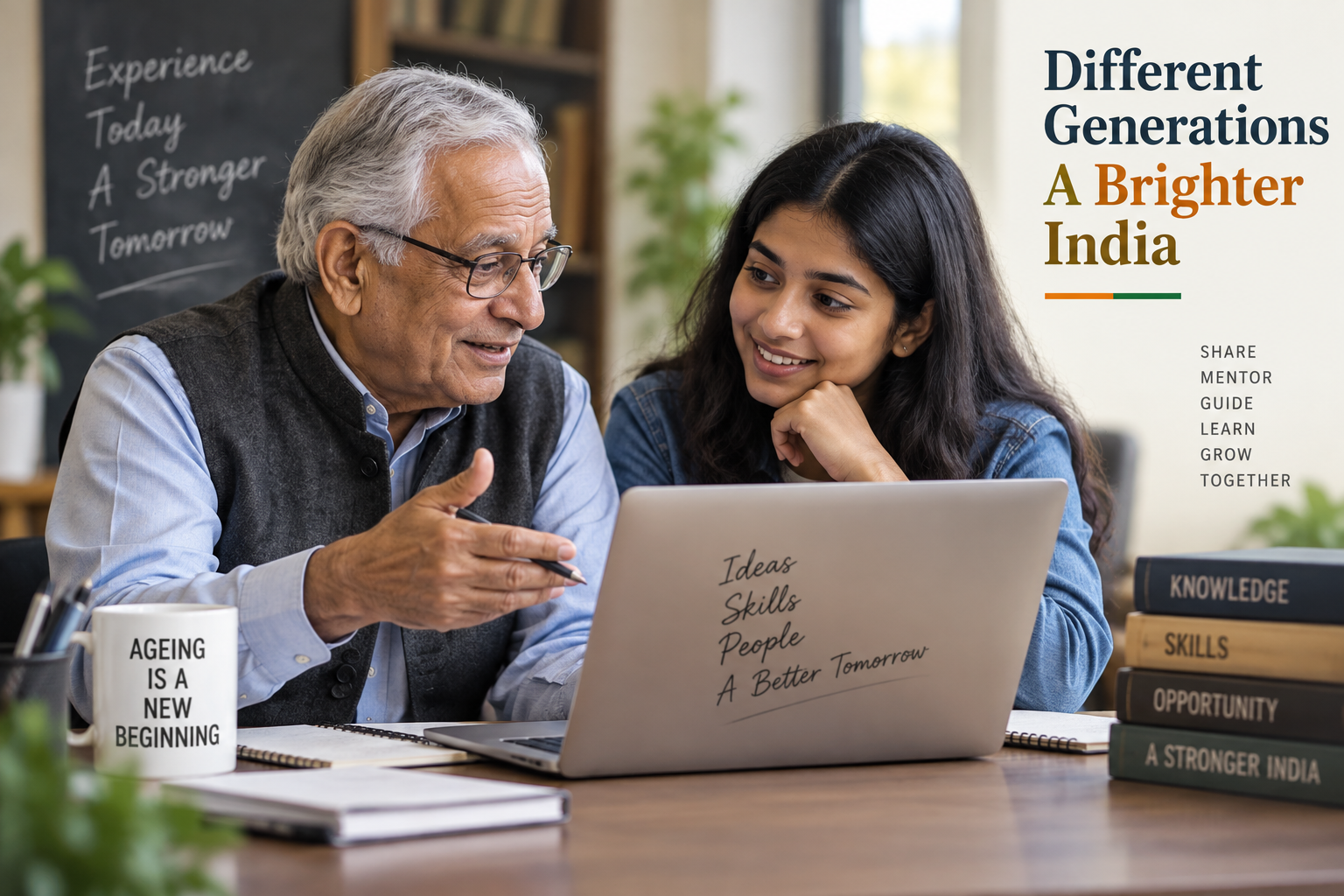
This is where ageing becomes more than an economic or healthcare issue. Loneliness among senior citizens is also about the loss of engagement and purpose. Work does not merely provide income; it creates relationships, identity and a sense of usefulness. For many retired people who remain capable and willing to contribute, therefore, one of the most meaningful forms of elder care may simply be to provide opportunities to remain useful.
And here lies India’s strange paradox.
On one side are millions of young Indians seeking employment but frequently requiring capabilities beyond their academic qualifications. They need better communication and language skills, financial literacy, digital familiarity, career counselling, interview preparation, workplace behaviour, entrepreneurship guidance, life skills and, above all, mentoring. India’s own Economic Survey has repeatedly emphasized the need to align skills with a rapidly changing labour market.
On the other side are millions of older Indians possessing precisely the accumulated experience that cannot easily be taught through textbooks or online courses. Yet there is hardly any institutional bridge connecting these two generations.
India has young people searching for skills and experienced people searching for purpose.
Why can a retired banker not spend a few hours every week teaching financial literacy to college students? Why cannot a retired teacher mentor children struggling with language or mathematics? An engineer could guide students at an ITI or polytechnic. A former corporate executive could prepare graduates for interviews and workplace expectations. Retired administrators could mentor social organizations and panchayats. Journalists could teach communication, critical thinking and media literacy. Entrepreneurs could guide young people attempting to start businesses.
None of this requires bringing people back into conventional full-time employment. Four or six hours of meaningful engagement every week could make a difference at both ends—providing knowledge and mentoring to the young while restoring engagement, recognition and purpose to the old.
India should consider creating a National Senior Knowledge and Skills Network through which willing retired people can register their professional expertise, skills, languages, location and availability. Schools, colleges, universities, ITIs, skill-development centres, libraries, NGOs, panchayats and community organizations could access this reservoir of experience. Some engagements could be voluntary; others could carry an honorarium or part-time remuneration.
The idea is not entirely absent from government thinking. The Atal Vayo Abhyuday Yojana already recognizes “active and productive ageing”, intergenerational bonding and skill development, and includes Senior Citizen Opportunities for Productive Engagement, or SCOPE. But productive ageing needs to move from the margins of senior-citizen welfare policy to the centre of India’s human-resource strategy.
There is, however, another side to ageing that cannot be ignored. People age differently, but as many move through their 70s into their 80s, the balance progressively shifts from contribution towards the need for care. India’s ageing population cannot be treated as one homogeneous category beginning at 60. A healthy 62-year-old professional and an 82-year-old struggling with mobility require very different public responses.
For the latter, society and the State must provide greater protection, comfort and dignity: specialized geriatric healthcare, home-based care, accessible transport, priority in public offices and hospitals, protection against financial exploitation and abuse, recreation, companionship and senior-friendly public spaces. India has laws and schemes covering several of these areas, but what elderly citizens often lack is a seamless, dependable ecosystem that makes everyday life easier. The challenge will become more urgent because the population above 80 is projected to grow particularly rapidly in the coming decades.
For generations, India assumed that families would take care of ageing parents. Nuclear families, migration, smaller households and children living in different cities or countries are weakening that assumption. Government policy itself now recognizes the decline of the joint-family support structure and the emotional, physical and financial vulnerabilities it can create for older people.
India therefore needs a new social contract with ageing. While people remain capable of contributing, society should create opportunities for them to remain useful. As they become more vulnerable, the same society must guarantee them care, protection, comfort and dignity.
India cannot afford to confuse retirement with redundancy. A country struggling to skill one generation should not simultaneously discard the accumulated knowledge of another. The real challenge of an ageing India is not merely helping people live longer. It is ensuring that they remain useful while they can contribute—and are cared for with dignity when they increasingly need support.

Your support to NYOOOZ will help us to continue create and publish news for and from smaller cities, which also need equal voice as much as citizens living in bigger cities have through mainstream media organizations.