Harari: Youth and Disruption of AI

  • | Friday | 28th August, 2026

By Animesh Ikshit

NEW DELHI: Every morning, millions of students go to school and college carrying textbooks that teach them how to remember, calculate and reproduce answers.

But what happens when the machines they will work alongside can remember more, calculate faster and process information better than any human? That is the question education systems can no longer avoid. Artificial intelligence is not merely changing the tools used at work. It is beginning to challenge the very skills around which modern education was designed.

The uncomfortable question

For decades, education prepared students for careers that could last 30 or 40 years. A degree was expected to provide a relatively stable professional foundation. That assumption is now under pressure. Students continue to spend years learning fixed procedures, memorising information and preparing for standardised examinations.

Yet many of the same abilities are increasingly becoming AI`s strength, ie. routine accounting, administrative work, translation, legal drafting, basic coding and data processing. If software can perform a task instantly after a student has spent years learning it, what exactly is the education system preparing that student for?

The concern is not that every job will disappear. It is that the economic value of many routine cognitive skills could fall much faster than education systems can change.

AI has found its “bureaucratic jungle”

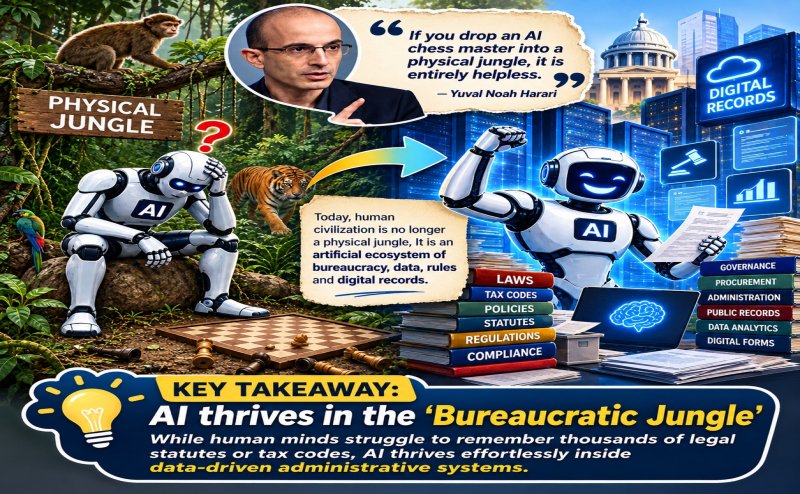
Historian and author Yuval Noah Harari offers a provocative way of understanding the change. He has argued in recent video discussions that an AI chess master placed in a physical jungle would be helpless. It cannot hunt, build shelter or survive in nature. Modern civilisation, however, is a different kind of jungle. It is made of language, laws, contracts, regulations, financial records, databases and bureaucratic systems.

That is precisely the environment in which AI can be exceptionally powerful. Harari`s argument is significant because humans created bureaucracy to manage complexity. But humans also have limited memory and attention. No individual can remember thousands of laws, regulations, tax provisions, contracts and administrative procedures.

AI does not have that limitation. The question, therefore, is no longer simply whether AI can replace a worker. What happens when AI becomes better than humans at navigating the systems through which society itself operates?

Education is still largely built for yesterday

The problem begins much earlier than employment. School and colleges reward students for remembering the correct answer. Competitive examinations reward speed and accuracy. Universities often divide students into rigid academic streams.

But AI changes the value of all three. The ability to retrieve information is becoming cheap. The ability to generate a first draft is becoming cheap. The ability to perform routine analysis is becoming cheap. What becomes more valuable is the ability to decide which question should be asked, whether an answer is trustworthy, what its consequences are and what should be done next.

That requires critical thinking, formal logic, ethics, judgement and adaptability. It also requires combining disciplines that education traditionally keeps apart. The student of the AI era may need to understand both computer science and philosophy; algorithms and ethics; data and human behaviour.

China is already moving

China provides a warning and perhaps a preview. Between 2021 and 2025, Chinese higher education institutions revoked or suspended 12,200 undergraduate programmes while introducing 10,200 new ones, according to Ministry of Education data reported by the South China Morning Post. More than 30% of university programmes underwent adjustments.

China`s Ministry of Education says the country is actively restructuring university programmes around labour-market demand, strategic technologies and emerging areas such as AI, robotics, data science and embodied intelligence.

This raises a question for India and other countries: How many students are currently being trained for occupations whose economic value may decline before they even reach the middle of their careers?

The bigger danger is not unemployment alone

The disruption may go beyond job losses. If workers must repeatedly learn new skills every few years, psychological resilience could become as important as technical competence.

At the same time, advanced AI requires enormous computing infrastructure and capital. If ownership of that infrastructure remains concentrated, productivity gains could increasingly flow towards capital owners while routine labour loses bargaining power.

There is another danger. AI systems trained on historical data can reproduce historical biases. Decisions about hiring, credit, education and access to services could therefore become automated without necessarily becoming fairer.

So what should a student learn?

The answer is not to stop teaching mathematics, science, coding or professional skills. It is to stop believing that knowledge alone is a career insurance policy. Students need to learn how to question machines, not merely use them. They need technical literacy without becoming technically narrow. They need philosophy without becoming disconnected from technology.

They need the ability to distinguish information from knowledge, prediction from judgement and efficiency from wisdom. The central question for education is therefore no longer: “What should students learn to get a job?” It is: “What should students learn when machines can increasingly do the jobs for which we are training them?

That may be the most important education question of the AI age.


If You Like This Story, Support NYOOOZ

NYOOOZ SUPPORTER

NYOOOZ FRIEND

Your support to NYOOOZ will help us to continue create and publish news for and from smaller cities, which also need equal voice as much as citizens living in bigger cities have through mainstream media organizations.


Stay updated with all the Delhi Latest News headlines here. For more exclusive & live news updates from all around India, stay connected with NYOOOZ.

Related Articles

Harari: Youth and Disruption of AI
  • Friday | 28th August, 2026
The National Blind Spot: Real Education?
  • Wednesday | 26th August, 2026