The National Blind Spot: Real Education?

  • | Wednesday | 26th August, 2026

By Animesh Ikshit

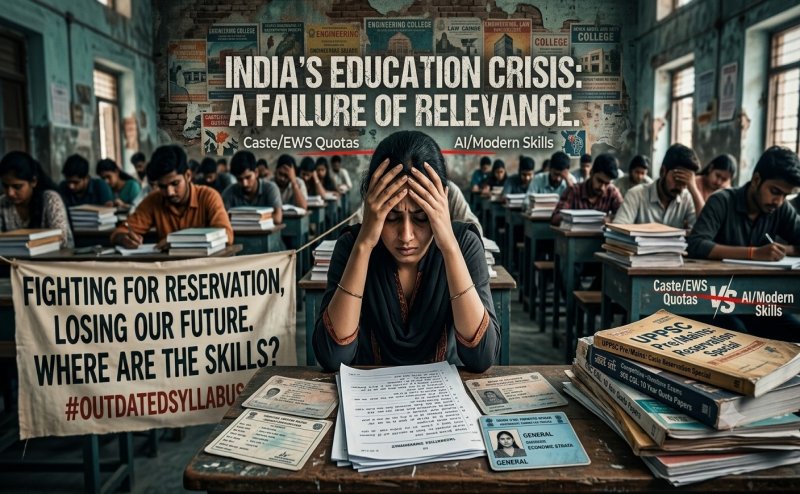
NEW DELHI, India’s higher education system is facing a severe breakdown, with less than 10% of college graduates working in jobs that match their qualifications, according to recent findings from NITI Aayog. In its latest report, Reimagining Skilling for Viksit Bharat @2047, the government policy think tank revealed that only 8.25% of degree holders are employed in roles aligned with their educational level. The data highlights a growing mismatch between university degrees and modern industry requirements.

Key Findings from the Report

  • Unemployment Rate: Joblessness among college graduates stands at 13%. This rate is nearly four times higher than India’s overall national unemployment rate of 3.2%.
  • Gender Disparity: The crisis disproportionately affects women. Unemployment among female graduates has passed 20%.
  • Generic Degrees: Over 2 crore of India`s 3.4 crore undergraduate students are enrolled in traditional BA, BSc, and BCom programmes. NITI Aayog flags these tracks for lacking direct job linkages.
  • Lack of Practical Training: 80% of higher education students report zero direct industry exposure or practical experience during their studies.
  • Government Job Rush: Millions of graduates rely on obsolete degrees solely to meet minimum eligibility criteria for public sector exams. Recent recruitment cycles saw 1.86 crore applications filed for just 55,000 government seats.

Who Is Affected?
The crisis impacts over 3.4 crore undergraduate students across India, particularly those in Tier-2 and Tier-3 private colleges. Employers also face major challenges, spending substantial capital to retrain new hires who lack functional workplace skills.

Where Is the Problem Occurring?
The skill gap spans higher education institutions across India. It is further exacerbated in major coaching hubs such as Kota, Patna, and Mukherjee Nagar, where millions of youth spend years preparing for government entrance tests that suffer from paper leaks and exam cancellations.


Why Is This Happening?

NITI Aayog attributes the crisis to outdated university syllabi, an over-reliance on generic degree courses, and the rapid growth of automation and artificial intelligence. While global markets require practical skills, Indian universities continue to evaluate students through rote memorisation and handwritten exams.

How Can the Crisis Be Solved?
To fix the structural breakdown, experts recommend four major interventions:

1. Pruning Outdated Courses: Phasing out generic degree tracks that train students for automated administrative roles.

2. Mandating Proof of Work: Shifting evaluations from three-hour memory tests to practical projects, open-source code contributions, and industry internships.

3. Ensuring Exam Security: Upgrading national entrance assessments to secure digital platforms to prevent paper leaks.

4.Integrating Industry with Academia: Aligning university curricula directly with private sector needs, research initiatives, and technological shifts.


If You Like This Story, Support NYOOOZ

NYOOOZ SUPPORTER

NYOOOZ FRIEND

Your support to NYOOOZ will help us to continue create and publish news for and from smaller cities, which also need equal voice as much as citizens living in bigger cities have through mainstream media organizations.


Stay updated with all the Delhi Latest News headlines here. For more exclusive & live news updates from all around India, stay connected with NYOOOZ.

Related Articles

The National Blind Spot: Real Education?
  • Wednesday | 26th August, 2026
CREDIT TRAPS: SOCIAL DISASTER
  • Wednesday | 26th August, 2026