Rebuilding India's social conscience: Beyond power & self

  • | Tuesday | 21st July, 2026

The response to the first two articles has been both encouraging and deeply reflective. Many readers resonated with the concerns raised and agreed that these are questions deserving a wider national conversation. If the first article explored the growing dominance of ‘Me’ over ‘We’, and the second examined our increasing obsession with power, influence and the desire to be treated differently, this concluding article asks the most important question of all: Can India rebuild its social consciencel? More importantly, how do we move beyond the pursuit of power and self to restore a stronger sense of citizenship, shared responsibility and social conscience? This concluding article attempts to explore that question.

By Alok Verma

The first article in this series argued that India appears to be witnessing a gradual erosion of civic and moral responsibility. The second explored why power, influence and borrowed identity have increasingly become social currencies in contemporary India. Together, they painted a picture that many readers may have found uncomfortable, perhaps even unsettling. Yet diagnosis is never the destination. Every society periodically reaches moments when it must pause, look inward and ask difficult questions about itself. The purpose of such introspection is not to cultivate pessimism but to discover the possibility of renewal. Every civilization that has endured has done so because it possessed the courage to correct itself before decline became irreversible. India stands at precisely such a moment.

Every civilization is ultimately held together not merely by laws, governments or economic arrangements but by an invisible social contract—its social conscience. Laws may define what citizens are permitted to do but social conscience determines what they feel they ought to do. It is the inner restraint that prevents a person from exploiting another even when no authority is watching; the empathy that makes another person’s suffering matter; and the recognition that individual freedom cannot be separated from responsibility towards society.

India’s Constitution understood this relationship with remarkable clarity. Its Preamble did not stop at liberty and equality. It placed fraternity alongside them, linking it directly with the dignity of the individual and the unity of the nation. Dr B.R. Ambedkar warned that political democracy could not endure unless it rested upon social democracy—a way of life founded on liberty, equality and fraternity. Article 51A later articulated citizens’ duties to promote harmony, protect public property, renounce practices derogatory to women, develop humanism and strive for excellence in individual and collective life. These were not ornamental additions to the Constitution. They represented the moral obligations without which rights and institutions cannot sustain themselves.

Social conscience, therefore, is not the same as personal goodness or religious belief. A person may be generous within the family and yet indifferent to injustice outside it. One may observe rituals faithfully and still discriminate against another human being. Social conscience begins when morality moves beyond the private self and enters public relationships. It asks whether we recognize the dignity of those who are socially weaker, economically poorer, politically voiceless or simply unknown to us.

India’s history offers powerful examples of such conscience in action. Mahatma Gandhi transformed sanitation, untouchability, communal harmony and dignity of labour from neglected social concerns into questions of national character. Swami Vivekananda placed service at the center of spiritual life and argued for an education that builds character rather than merely transmitting information. Vinoba Bhave’s Bhoodan movement attempted to persuade landowners to voluntarily share land with the landless, seeking transformation not through coercion but through awakening social responsibility.

Later, Verghese Kurien demonstrated that trust could be converted into durable economic institutions. The Amul cooperative model gave dairy farmers ownership, representative control and professional management, showing that collective enterprise could combine dignity, efficiency and participation. Ela Bhatt’s Self-Employed Women’s Association similarly organized women in the informal economy around self-reliance, cooperation, dignity of labour and economic agency. SEWA grew not through charity but by enabling women to become members, workers, owners and decision-makers. These examples matter because they show that social conscience is not sentiment. It can be institutionalized.

India today invests heavily in physical, digital and financial infrastructure. Roads reduce distance, digital networks expand access and financial systems connect citizens to markets. But a developed society also requires moral infrastructure—trust, fairness, empathy, integrity, reciprocity and respect for human dignity. Without it, even efficient institutions become vulnerable to manipulation, public policy loses legitimacy and citizens increasingly view one another as competitors for privilege rather than partners in a common national enterprise.

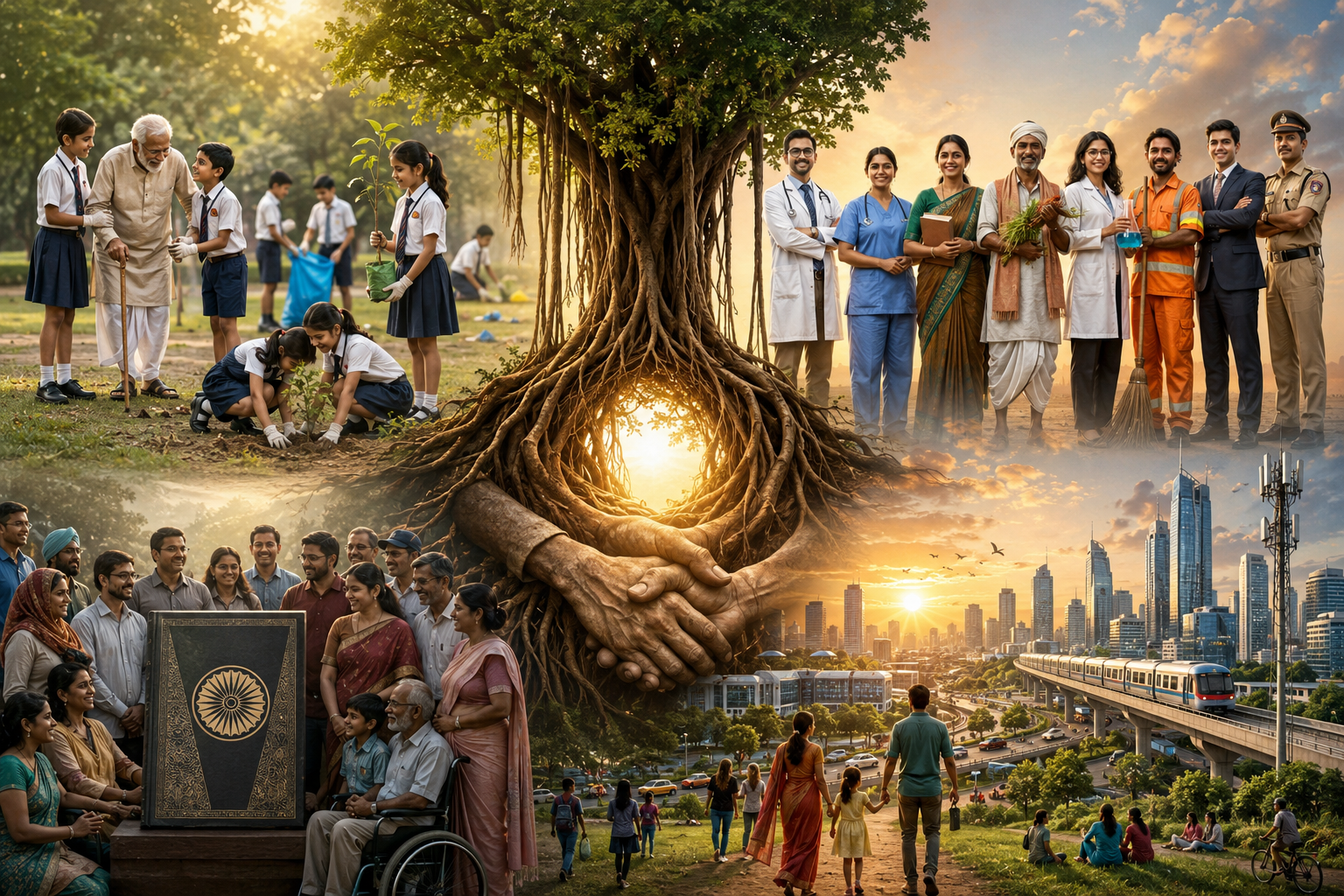
Who builds this moral infrastructure? No single government can. Families create its first habits by showing children how domestic workers, women, elders and strangers are treated. Schools must convert constitutional values into lived practices of cooperation, service, dialogue and fairness. Religious and spiritual institutions must connect faith with compassion rather than identity alone. Businesses must recognize that ethical conduct towards workers, consumers and communities is not philanthropy but responsibility. Political leadership must demonstrate that public office is a trusteeship, not an entitlement. The media must expose wrongdoing, but it must also make visible those individuals and institutions that strengthen social trust.

India should therefore consider a national Social Conscience Mission as it approaches 2047—not another government publicity campaign but a long-term societal movement involving schools, universities, local bodies, civil society, faith organizations, media and corporate institutions. Its progress should be assessed through indicators such as volunteering, gender respect, protection of public property, institutional trust, community engagement, zero tolerance to corruption and willingness to assist those beyond one’s immediate circle.

India’s earlier national movements sought political freedom, food security, scientific self-reliance and economic growth. The next great movement must seek a society in which conscience keeps pace with ambition. A nation becomes truly developed not when its citizens merely acquire greater wealth and power but when they use both with restraint, fairness and responsibility. Rebuilding India’s social conscience is therefore not a moral luxury. It is the essential infrastructure of the civilization India now aspires to become.

(The writer is a national award-winning senior journalist and founder Newzstreet Media)


Read the first and second part here

Treat me differently: India`s new obsession with power display

Is India losing its social conscience?


If You Like This Story, Support NYOOOZ

NYOOOZ SUPPORTER

NYOOOZ FRIEND

Your support to NYOOOZ will help us to continue create and publish news for and from smaller cities, which also need equal voice as much as citizens living in bigger cities have through mainstream media organizations.


Stay updated with all the Delhi Latest News headlines here. For more exclusive & live news updates from all around India, stay connected with NYOOOZ.

Related Articles