When Credit Becomes a Trap: The Lending Beyond Means

  • | Sunday | 23rd August, 2026

BY-Animesh Ikshit 

Easy credit has changed the way India consumes. But when the ability to borrow grows faster than the ability to repay, the monthly EMI can quietly become a lifetime burden.


There was a time when borrowing money was accompanied by hesitation. A loan meant paperwork, questions, collateral and, most importantly, a conversation with the family about whether the money could actually be repaid.

That hesitation is disappearing.

Today, a person can walk into a shop, open a mobile application or click a few buttons online and obtain credit almost instantly. A smartphone, television, motorcycle, holiday, furniture or even a meal can be converted into a monthly payment. The language has changed too. We no longer ask, “Can I afford this?” We ask, “How much is the EMI?”

That small change in vocabulary represents a profound change in consumer behaviour.

The EMI makes an expensive purchase appear inexpensive. ₹80,000 becomes “just ₹4,999 a month”. A ₹5 lakh loan becomes “only ₹11,000 a month”. The total liability disappears behind the comfort of a smaller number.

And therein lays the trap.

The affordability illusion


Credit itself is not a bad thing. Responsible borrowing can create homes, businesses, education and productive assets. A loan that helps a person acquire an asset or generate additional income can be a powerful instrument of economic mobility.

The problem begins when credit is used to finance consumption that the borrower cannot genuinely afford.

The danger is particularly acute when several small loans accumulate. A consumer may have a credit-card balance, a personal loan, a vehicle EMI, a mobile-phone EMI, a Buy Now Pay Later obligation and perhaps a loan taken through an app. Individually, none appears overwhelming.

Together, they can consume a frightening proportion of household income.

This is how financial distress often develops—not through one spectacular borrowing decision, but through a series of apparently harmless monthly commitments.

The question therefore should not be, “Can I get the loan?”

It should be, “Can my household comfortably repay it even if something goes wrong?”

That is a very different question.

India is borrowing more for consumption


The broader trend deserves attention. The Reserve Bank of India has highlighted the increasing importance of consumption-oriented borrowing in household debt. By March 2025, household debt was estimated at 41.3% of GDP, above its five-year average, with non-housing retail loans—largely consumption-oriented—forming the dominant category. (Business Standard)

The latest RBI Financial Stability Report, released in June 2026, also put household debt at 45.5% of GDP as of September 2025 and identified consumption loans as an important driver of the increase. (Reuters)

These numbers do not mean that India is facing a household-debt crisis. Nor does borrowing automatically imply financial irresponsibility. But they do tell us something important: credit is increasingly becoming a mechanism for consumption, not merely for asset creation.

That distinction matters.

Borrowing to build a house is fundamentally different from borrowing to maintain a lifestyle that one`s income cannot support.

The lender`s responsibility


Much of the discussion about debt focuses on the borrower.

That is only half the story.

A lender is not merely selling money. A lender is selling a financial obligation that may remain with the customer for months or years. Therefore, lending responsibly should mean more than establishing whether an applicant technically qualifies for a loan.

The real question should be whether the borrower can reasonably service the proposed debt.

Technology has made credit assessment faster than ever. Income information, banking history, credit scores and transaction patterns can be processed within seconds. But an algorithm can determine eligibility without necessarily understanding the human circumstances behind the numbers.

A young person may qualify for a loan because the system sees a clean credit history. It may not see that the household is already supporting elderly parents, paying school fees or servicing several other loans.

The RBI already recognises the importance of household-level indebtedness in certain lending frameworks. For microfinance lending to low-income households, regulated entities must assess household income and indebtedness, with monthly loan repayment obligations subject to a maximum 50% of monthly household income. (Reserve Bank of India)

The broader principle is worth considering well beyond microfinance:

The ability to borrow should never be confused with the ability to repay.

The borrower has a responsibility too


Consumers cannot place the entire responsibility on lenders.

Easy credit is an invitation, not an instruction.

Before taking a loan, every borrower should calculate the total monthly debt obligation—not just the EMI being offered for the new purchase.

If a household earns ₹60,000 a month and already pays ₹20,000 towards existing loans, another ₹10,000 EMI is not “only ₹10,000”. It is an additional commitment consuming another 16.7% of household income.

And income itself is not guaranteed.

A job can disappear. A business can slow down. A medical emergency can arrive without warning. A family responsibility can suddenly increase.

A financially prudent household therefore needs a buffer between its regular income and its mandatory monthly commitments.

The objective should not be to maximise the loan one can obtain.

It should be to minimise the probability of being unable to repay it.

The social pressure to borrow


There is another dimension that financial spreadsheets cannot capture.

Consumer credit is increasingly intertwined with social identity.

A premium smartphone can become a symbol of success. A large car can become a statement of status. An expensive wedding can become a measure of family prestige. A foreign holiday can become a social-media necessity.

The product is no longer being purchased merely for its utility.

It is being purchased to demonstrate that one belongs.

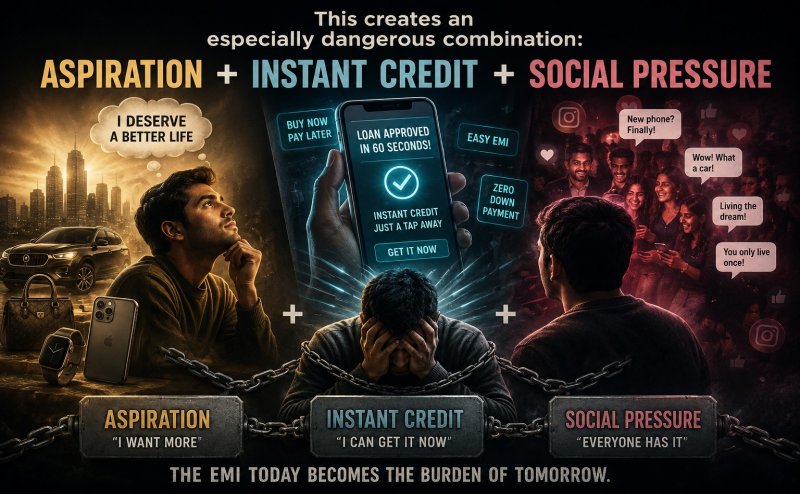
This creates an especially dangerous combination: aspiration + instant credit + social pressure.

When an individual cannot afford the lifestyle through income, credit provides the bridge.

But the bridge has to be paid for every month.

Social media shows the holiday. It does not show the EMI.

It shows the new car. It does not show the loan statement.

It shows the unboxing. It does not show the interest accumulated over the repayment period.

When debt begins to consume tomorrow


The most dangerous characteristic of excessive borrowing is that it steals from future income.

A person earning tomorrow`s salary has already spent part of it today.

Do that repeatedly and future income becomes increasingly pre-committed. Eventually, the borrower reaches a point where salary day is no longer a day of financial freedom. It becomes the day on which yesterday`s purchases are paid for.

This is particularly damaging for young people.

The early years of employment should ideally be used to build an emergency fund, acquire skills, invest and create assets. Instead, excessive consumer debt can turn them into years of servicing yesterday`s consumption.

The irony is painful: a person may appear financially successful while actually becoming financially weaker.

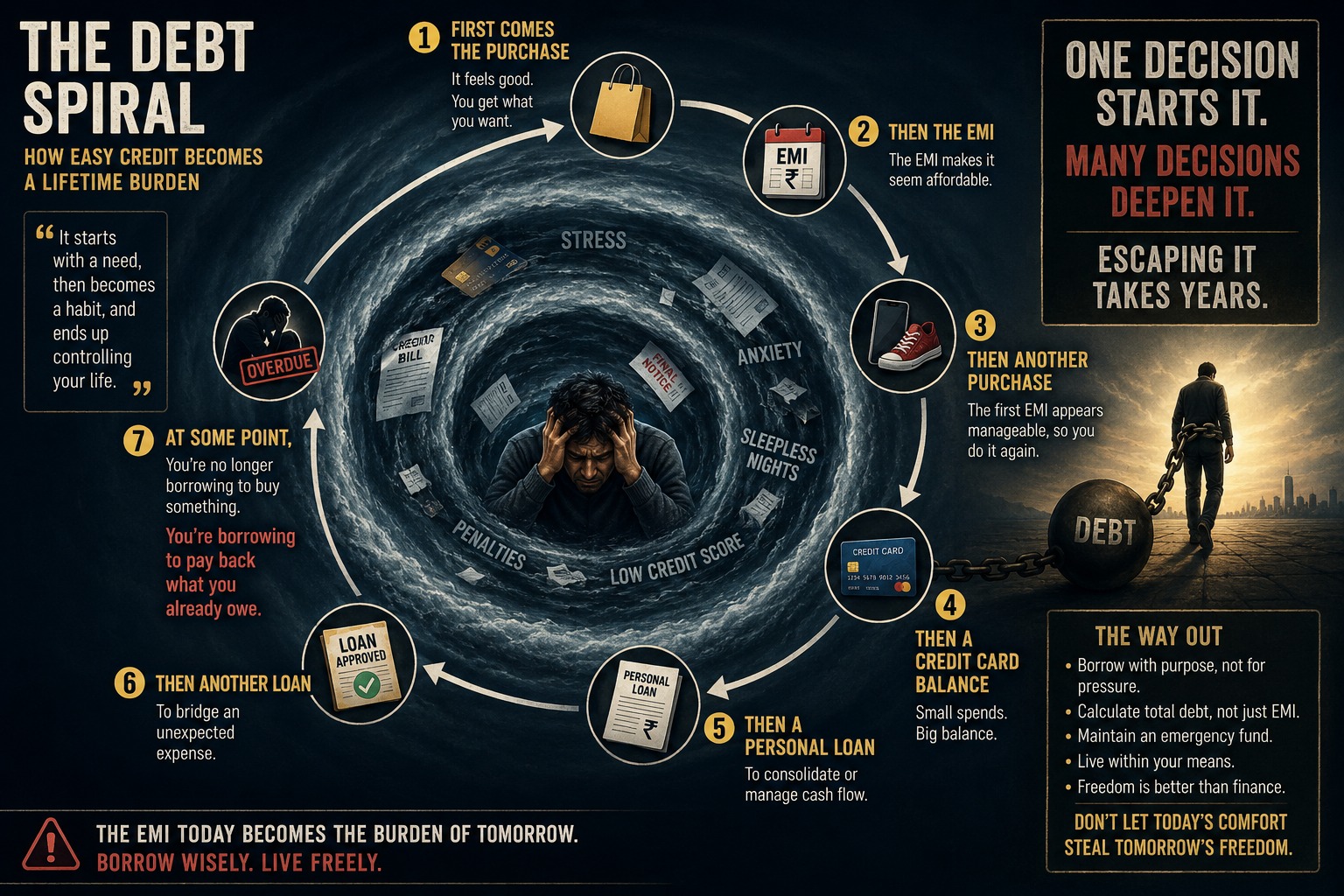
The debt spiral

The pattern is remarkably predictable.

First comes the purchase.

Then the EMI.

Then another purchase because the first EMI appears manageable.

Then a credit-card balance.

Then a personal loan to consolidate or manage cash flow.

Then another loan to bridge an unexpected expense.

At some point, the borrower is no longer borrowing to buy something.

The borrower is borrowing to service previous borrowing.

That is the moment when credit stops being a financial tool and starts becoming a trap.

Late payments bring penalties. Credit scores deteriorate. New borrowing becomes expensive. Collection pressure increases. Family relationships come under strain.

The financial problem eventually becomes a psychological problem.

We need a culture of “Can I afford it?”


India rightly wants greater financial inclusion. Access to formal credit is an important part of a modern economy. RBI has itself placed increasing emphasis on financial literacy, with 2,421 Centres for Financial Literacy operational across the country as of March 2025. (Reserve Bank of India)

But financial inclusion cannot simply mean putting more people inside the credit system.

It must also mean giving people the knowledge to use credit safely.

The simplest financial education may therefore be the most powerful:

Don`t ask what the EMI is. Ask what the total repayment is.

Don`t ask whether you qualify. Ask whether you can afford it.

Don`t calculate against today`s income. Calculate against a difficult year.

And perhaps most importantly:

Don`t borrow to maintain an appearance that your income cannot sustain.

Credit should create tomorrow, not consume it


There is nothing wrong with aspiration.

People should want better homes, better education, better mobility and better lives for their families. Credit can help make those aspirations possible.

But aspiration becomes dangerous when it outruns income indefinitely.

A healthy credit system should help people move forward—not keep them permanently paying for the past.

Lenders must therefore ask harder questions before extending credit, particularly where multiple unsecured loans are already visible. Borrowers, meanwhile, must accept that every easy EMI is a commitment against future income.

The real measure of financial success is not how much one can buy today.

It is how much financial freedom one still has tomorrow.

In the end, the most expensive loan is not necessarily the one with the highest interest rate.

It is the loan that you were never in a position to repay.


If You Like This Story, Support NYOOOZ

NYOOOZ SUPPORTER

NYOOOZ FRIEND

Your support to NYOOOZ will help us to continue create and publish news for and from smaller cities, which also need equal voice as much as citizens living in bigger cities have through mainstream media organizations.


Stay updated with all the Delhi Latest News headlines here. For more exclusive & live news updates from all around India, stay connected with NYOOOZ.

Related Articles