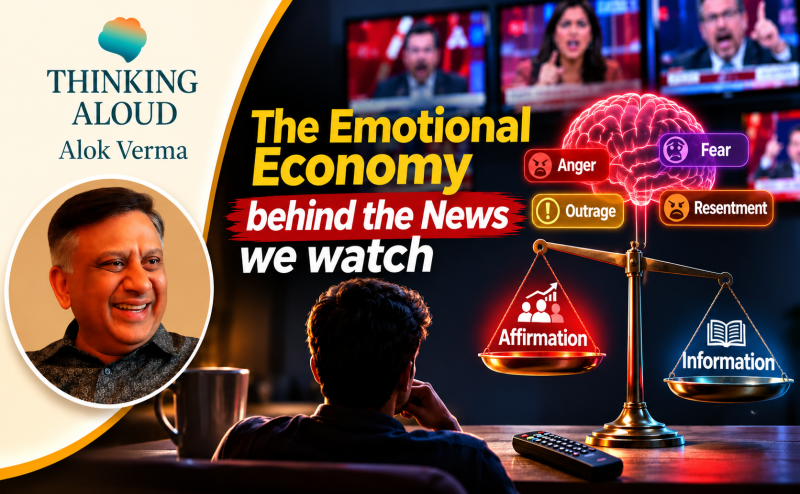
The emotional economy behind the News we watch

  • | Wednesday | 4th November, 2026

Are we watching the news to understand the world or to reaffirm what we already believe?

BY- Alok Verma


From Social Media Engagement to Indian Television News: How Human Emotions Shape Audience Loyalty and the Business of Attention

What makes millions of Indians return to their preferred television news channels every evening? Is it their desire to remain informed or the satisfaction of watching their existing beliefs, frustrations and prejudices being repeatedly affirmed? The question becomes particularly relevant when examined alongside social media, where anger, outrage, fear and resentment have emerged as powerful drivers of audience engagement. Is a similar emotional economy influencing Indian television news, where attracting and retaining viewers is central to commercial survival?

Social media platforms have demonstrated how human emotions can be converted into measurable engagement. An angry reaction, provocative comment or contentious post can trigger an extended cycle of arguments and counterarguments. Each interaction contributes to the visibility and circulation of content. The platforms do not necessarily create these emotions. Their commercial systems can benefit from identifying and amplifying what already exists within their users.

Research supports this behavioral mechanism. A 2021 study published in Science Advances by William Brady and colleagues, examining millions of tweets, found that positive social feedback reinforced expressions of moral outrage, increasing the likelihood of similar behavior in the future. The finding suggests that digital engagement can encourage repeated emotional expression rather than merely reflect existing sentiments.

Indian television news operates differently, but the commercial incentives invite comparison. Unlike social media algorithms, television channels depend on editorial selection, anchor personalities, debate formats and audience ratings. Yet both compete for sustained attention. Television sensationalism predates social media, but the convergence of broadcasting and digital platforms has created new opportunities to circulate emotionally charged content.

A 2024 study by Kiran Garimella of Rutgers University and Abhilash Datta of IIT Kharagpur examined the relationship between television debates and social media engagement surrounding Arnab Goswami — The Debate. It demonstrated how television programming and online conversations interact through hashtags and audience participation. A confrontational exchange broadcast during prime time can subsequently circulate through digital platforms, extending its reach and emotional impact.

The commercial pressures surrounding Indian television provide another important dimension. According to the FICCI–EY media and entertainment report released in March 2026, linear television advertising revenue declined from ₹31,200 crore in 2023 to ₹26,300 crore in 2025. News channels accounted for approximately 26% of television advertising volume in 2025, underscoring the genre`s dependence on advertising-supported attention.

The relationship between public anxiety and news consumption is equally revealing. BARC data reported by Mint showed that approximately 507 million viewers watched television news during the week of Operation Sindoor in May 2025. During May 7–9, news accounted for 16% of total television viewing compared with its usual share of around 6%. Such increases reflect legitimate public demand during crises, not evidence of deliberate sensationalism. Nevertheless, they demonstrate how uncertainty and perceived threats can command extraordinary audience attention.

The more consequential question is what happens when the emotional intensity associated with exceptional events begins influencing everyday editorial presentation.

Indian society carries unresolved economic anxieties, political frustrations, social inequalities and competing aspirations. News organizations have a responsibility to investigate these conditions and explain their causes. But have sections of television news discovered that repeatedly affirming these frustrations and antagonisms can create a dependable relationship with viewers?

Consider the distinction between investigating unemployment through evidence, policy and economic analysis and presenting the same issue primarily through accusations and political confrontation. Both may attract audiences, but one emphasizes understanding while the other may offer immediate emotional satisfaction.

This raises an important distinction between audience loyalty based on journalistic credibility and loyalty based on emotional affirmation. Viewers may return because they trust a channel`s reporting or because its familiar editorial position repeatedly validates their convictions. The latter relationship may be particularly durable because an individual controversy eventually fades while the emotional reassurance of a preferred worldview can continue.

The Reuters Institute`s Digital News Report 2026 found that 52% of surveyed Indian online news users sometimes or often avoided news while overall trust stood at 39%. Although the sample was not nationally representative, these findings raise questions about whether repetitive confrontation is strengthening audience attachment among some viewers while alienating others.

There is insufficient evidence to conclude that confrontational journalism consistently generates greater profits than constructive reporting. However, research on emotional engagement, documented combative television formats and the economics of audience measurement provide compelling grounds for examining the relationship.

The concern is not that journalism provokes anger. Reporting on injustice and wrongdoing must sometimes do precisely that. The distinction is between journalism that uses emotion to deepen understanding and programming that uses events primarily to sustain emotional stimulation.

Social media has demonstrated the commercial potential of engaging human emotions. Indian television news faces a comparable test of its editorial priorities.

If audience loyalty increasingly depends on affirming existing anxieties and antagonisms, what incentive does a news channel have to challenge the very assumptions that keep its viewers returning?

(The writer is Senior and National Awarad winning journalist and founder, Newzstreet Media)


If You Like This Story, Support NYOOOZ

NYOOOZ SUPPORTER

NYOOOZ FRIEND

Your support to NYOOOZ will help us to continue create and publish news for and from smaller cities, which also need equal voice as much as citizens living in bigger cities have through mainstream media organizations.


Stay updated with all the Delhi Latest News headlines here. For more exclusive & live news updates from all around India, stay connected with NYOOOZ.

Related Articles